




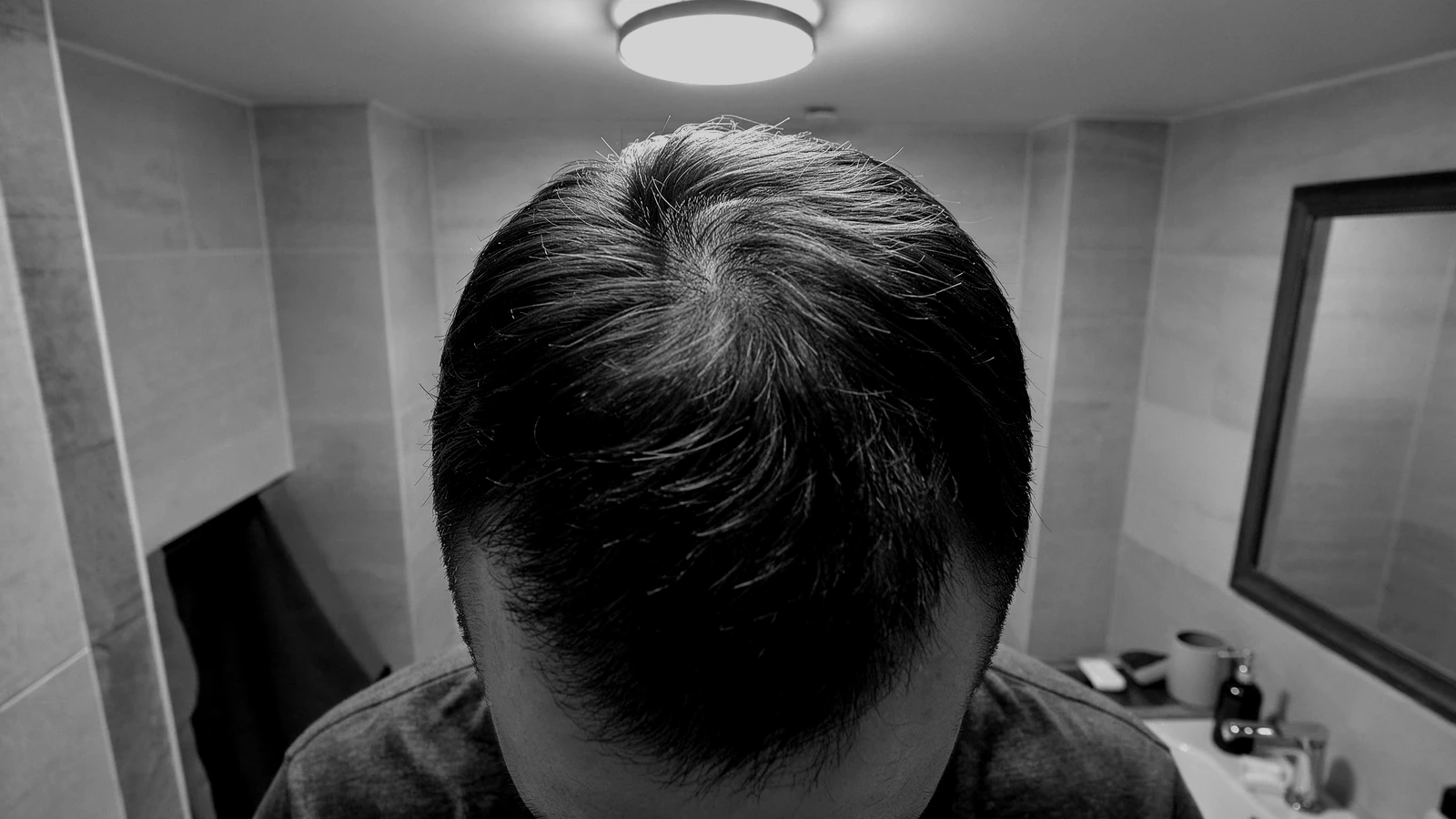
The quick answer: everyone has a crown whorl – the spiral point where hair changes direction – and under harsh overhead light or with wet hair it can look like a bald spot even when it is perfectly normal. Early balding at the crown looks different: the thinner area slowly widens over months, the hairs in it become finer and shorter than the hair around it, and it often goes hand in hand with some recession at the temples. To tell the difference, photograph your crown in the same light every few months and look at the hairs, not just the skin. If the area is growing, get it assessed early.
The crown is the one part of your head you never see properly, which is why so many men discover a “bald spot” by accident – in a lift mirror, a holiday photo or, as one celebrity reportedly discovered this month, in photos shared widely on X. Interest is rising: UK Google searches for “thinning crown” have more than doubled compared with last year’s average. This guide explains what is normal, what is not and what you can do. For the wider picture, see our guide to male pattern baldness.
Why the crown is so hard to judge
- The whorl. At the crown, hair grows outwards in a spiral from a central point. Hair naturally parts there, so a little scalp always shows. Some people have two whorls, or a whorl that sits to one side – a “cowlick”.
- Lighting. Bright downlights, such as in bathrooms, lifts and changing rooms, shine straight through hair and onto the scalp. Almost anyone’s crown looks thin under them.
- Wet or freshly washed hair. Wet hair clumps together and exposes the scalp. Fine hair also looks thinner when it is very clean and flat.
- Short haircuts. A fresh short cut at the crown removes the length that usually covers the whorl.
- You never see it. Without a baseline, any photo can be a shock. That does not mean it has changed.
Natural whorl or thinning crown? A side-by-side guide
| Feature | Natural crown whorl | Early crown thinning (pattern loss) |
|---|---|---|
| Shape | Small spiral point; hair radiates out from it | A round or oval area of reduced density that spreads outwards |
| Over time | Looks the same in photos years apart | The area gets wider over months to years |
| Hair in the area | Same thickness and colour as the surrounding hair | Finer, shorter, lighter hairs mixed in (miniaturisation) |
| In different light | Looks much better in soft daylight and with dry, styled hair | Still visible in soft light and with dry hair |
| Elsewhere | Hairline unchanged | Often some temple recession too |
Clinicians call crown thinning “vertex” loss. On the Norwood scale it appears as stage 3 vertex and, as it progresses, stages 4 and 5, where the thin crown and receding hairline are separated by a band of hair. The British Association of Dermatologists describes loss of hair from the top of the head, with the sides and back spared, as part of the usual pattern in men.
How to check your crown properly
- Use the same set-up every time. Same room, same light (soft daylight from a window is best), dry hair, no product, about the same time since your last haircut.
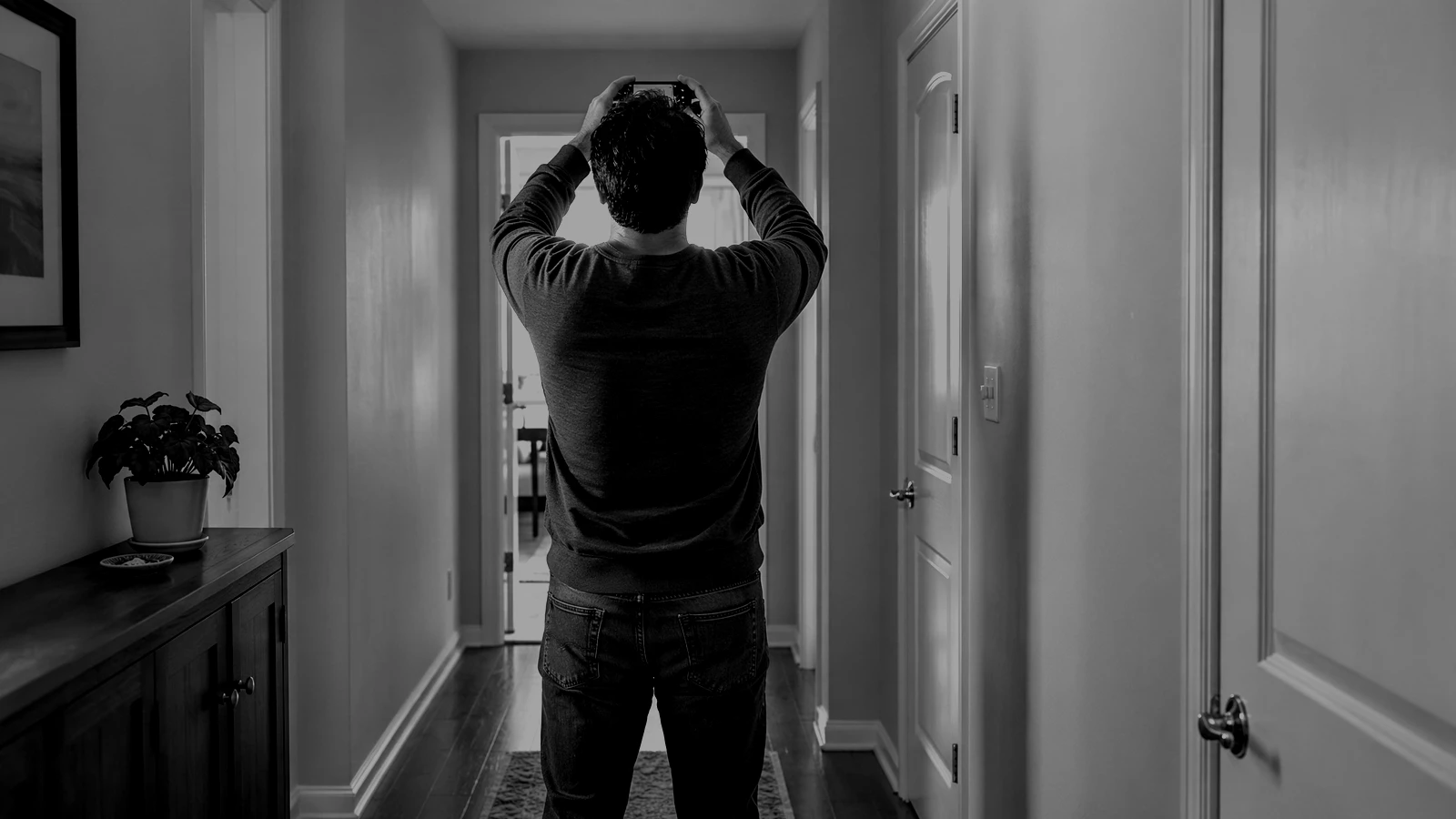
- Take two photos. One from directly above and one from behind at a slight angle. Ask someone else, or use your phone’s timer and a second mirror.
- Repeat every three months. Compare them side by side, not from memory.
- Look closely at the hairs. Are there lots of short, fine hairs in the centre that you don’t see at the sides? That is more telling than how much skin shows.
- Check your hairline at the same time – see our guide to a receding hairline vs a mature hairline.
Other reasons the crown can look thin
- Shedding. All-over shedding (telogen effluvium) after illness, stress, surgery or a crash diet shows first where hair is already finest – often the crown. It is usually sudden, with lots of full-length hairs in the shower, and tends to settle once the trigger passes.
- Scalp conditions. A greasy, flaky or itchy crown can be seborrhoeic dermatitis, which deserves its own routine. In the twin study published in Plastic and Reconstructive Surgery, dandruff was linked with more hair loss at the front, and longer periods of stress, heavy drinking and smoking with more thinning at the crown.
- Nutrition and weight loss. Low iron or not eating enough protein while training or dieting can contribute to shedding. See protein for hair loss and, if relevant, GLP-1 medicines and male pattern hair loss.
- Genes and gym myths. Crown thinning often runs in families – see is baldness genetic? – while the popular idea that creatine causes it is not supported by current evidence: see creatine and hair loss.
- Bald patches. A smooth, round patch, rather than gradual thinning, is not pattern loss – see your GP.
See your GP if the crown changed quickly, if the scalp is red, sore or scaly, or if hair loss comes with other symptoms such as tiredness or weight changes.
What helps a thinning crown look fuller
Get a baseline
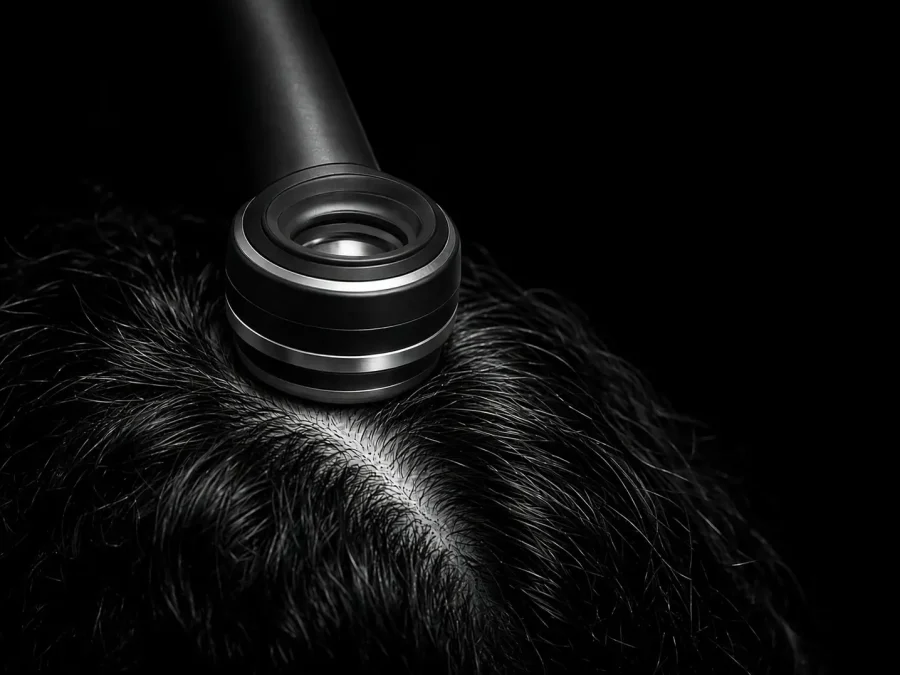
A hair and scalp analysis measures density at the crown and compares it with the back of the head, which is usually spared. It turns “I think it looks thinner” into numbers we can track.
Know your medical options
The crown is where the licensed medicines for pattern hair loss have been studied most. Minoxidil is available from pharmacies; finasteride needs a prescription and carries MHRA warnings about psychiatric and sexual side effects. Both only work while they are used. Your GP or pharmacist can help you weigh them up – our male pattern baldness guide summarises the evidence.
Look after the scalp – consistently
The crown responds best to a routine you keep up for months. Our usage protocol for pattern thinning is built in three steps:
| Step | Product | How often |
|---|---|---|
| Prepare | Dermo Capillary Mask Activated Plus, micro-peel mode: massage 1–2 minutes, leave 3–5 minutes, rinse | 1–2 times a week, before washing |
| Cleanse | Hair Loss Prevention Shampoo Plus alternated with Hair Nutrient Royal Jelly Shampoo Plus: massage 1–2 minutes, leave 2–3 minutes, rinse | 3–4 times a week |
| Core leave-in | PROALOPEX+, in sections across the crown, massaged in for 1–2 minutes, not rinsed | Daily or 5 times a week for 12 weeks, then 3 times a week |
| If shedding is active too | Dixidox Forte Advance Plus | Morning and evening for 10 days, then once a day or 3–5 times a week for 6–8 weeks |
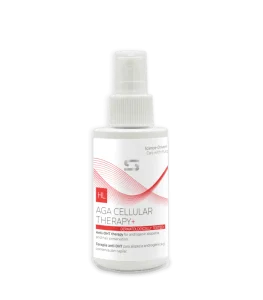
For early to moderate thinning with an oily scalp, AGA Cellular Therapy Plus can complement the core leave-in (daily or 5 times a week for 8–12 weeks, then 3 times a week), and DNA Hairmax Pro Plus can be alternated in as support. The full programme runs for around 11 months. Our shampoos, conditioners and masks are made with the TFD System; the leave-in serums have their own formulas without exosomes. They are cosmetics – they support a healthier-looking scalp and help hair look fuller and denser, rather than changing the underlying pattern.
If your hair is fine and flat, Volume Therapy Shampoo Plus is an optional extra on non-protocol wash days.
Style and habits
- Ask your barber to leave a little more length and texture at the crown, or go shorter all over to reduce contrast.
- Dry your hair with your fingers lifting at the roots rather than flattening it with a towel; a light matte product adds grip without clumping.
- Protect the crown from the sun with a hat or sun cream – it is one of the most sun-exposed areas of the scalp.
- Gentle scalp massage while washing is pleasant and helps the products spread evenly; there is no need to scrub. See our guide to scalp massage.
Your questions answered
Is a thinning crown always male pattern baldness?
No. A natural whorl, harsh lighting or wet hair can make any crown look thin, and shedding after illness or stress often shows at the crown first. Pattern loss is gradual, widens over time and comes with finer, shorter hairs in the area.
How can I tell a cowlick from a bald spot?
A cowlick or whorl is a spiral point where hair changes direction; the hair around it is normal thickness and it looks the same in photos years apart. A thinning crown is a widening area of finer hair that is still visible in soft daylight with dry hair.
At what age does the crown start thinning?
It varies. Some men notice crown thinning in their twenties, others not until their forties or later. Around half of men have some pattern hair loss by 50, and the crown and temples are the usual places it starts.
What haircut is best for a thinning crown?
Usually a shorter, textured cut with shorter sides, so the crown does not stand out against thick sides, or a short crop all over. Avoid growing the top long to cover the crown, which tends to separate and show more scalp.
How long before a scalp routine makes a difference to the crown?
Think in months. Hair grows roughly a centimetre a month and each follicle has its own cycle, so I review crown photos at three, six and twelve months rather than week to week.
Sources
- British Association of Dermatologists. Hair loss – male pattern (androgenetic alopecia), patient information leaflet. Updated June 2024.
- Alopecia UK. Pattern hair loss. Updated 6 February 2026.
- Norwood OT. Male pattern baldness: classification and incidence. Southern Medical Journal 1975.
- Gatherwright J et al. The contribution of endogenous and exogenous factors to male alopecia: a study of identical twins. Plastic and Reconstructive Surgery 2013.
- MHRA. Drug Safety Update: finasteride – psychiatric and sexual side effects. 29 April 2024.
- NHS. Hair loss.
This article is for general information and does not replace advice from your GP, pharmacist or another health professional. SIMONE TRICHOLOGY products are cosmetics, not medicines: they do not diagnose or correct male pattern hair loss or any other medical condition. If you are worried about your hair loss, please speak to your GP.