



Home › Trichology for beginners › Chapter 05
Hair Shaft Defects
The most common hair shaft defects, from everyday split ends and breakage to structural genetic disorders — and which respond to fibre care.
 Est. 1989 — Spain
The hair shaft is built from three layers — the cuticle, the cortex and the medulla. When genetics, an underlying condition or everyday damage alter those layers, the fibre can become fragile or change in texture and appearance. These are the hair shaft defects.
Understanding hair shaft defects
Trichology classifies hair shaft defects along two axes. The first is fragility: some defects make the fibre break easily, while others change its look or feel without weakening it. The second — and the most useful one in practice — is origin: whether the defect is acquired (caused by external damage and therefore often preventable and improvable) or structural / congenital (built into the fibre, usually genetic).
Acquired defects
Caused by heat, chemical processing, aggressive brushing, friction or environmental wear. The most relevant in everyday life — and the ones a good fibre-care routine can genuinely help.
Structural defects
Built into the fibre, usually genetic and often present from infancy. They are diagnosed with trichoscopy/microscopy and managed by a specialist — not corrected cosmetically.
Identifying which group a fibre belongs to is what matters: it tells you whether the answer is a better routine, or a referral.
Acquired defects
These are by far the most common. They develop on normal hair exposed to enough mechanical, thermal or chemical stress — and they are the ones that respond to prevention and fibre-repair care.
Split ends
Trichoptilosis
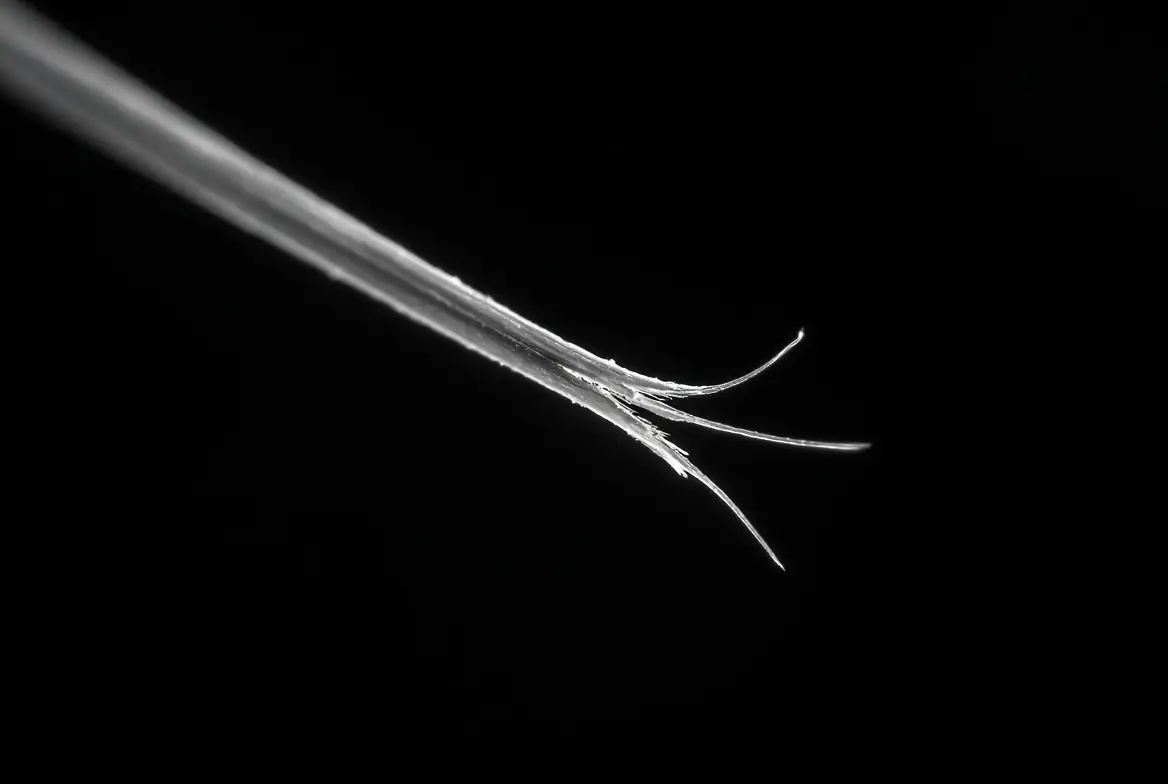
The classic longitudinal splitting of the fibre at its distal (far) end into two or more strands, like a frayed rope. It appears when the protective cuticle has been worn away by repeated brushing, heat styling, chemical processing and weathering, leaving the inner cortex exposed and prone to splitting.
Trichoptilosis is essentially cosmetic. Once the fibre has split, the split itself cannot be permanently “sealed”, but further damage can be prevented and the look and feel of the hair clearly improved with the right care.
Trichorrhexis nodosa (acquired)
The most common hair shaft abnormality
Recognised as the most common structural abnormality of the hair shaft caused by damage to the cuticle. Small whitish nodes form along the fibre; under magnification the hair fractures at those nodes into a characteristic brush-like appearance, as if two brooms were pushed together. The split ends of trichoptilosis often develop from these fractures.
In its acquired form it is driven by everyday trauma — excessive brushing, heat, chemical products and friction. Guidance from the literature is consistent and practical: avoid excessive brushing, heat, wind, salt and chemical products, and use mild shampoos and conditioner.
Note: trichorrhexis nodosa can also appear in a less common congenital form, or secondary to a structural weakness of the fibre — those cases belong with the structural defects below.
Structural defects
These are built into the fibre, usually genetic and present from the first months of life. They are not caused by hair care and cannot be corrected with cosmetics — they are diagnosed with trichoscopy or microscopy and managed by a dermatologist or specialist. They are included here for recognition, not for self-treatment.
Monilethrix
“Beaded hair”
An autosomal-dominant disorder, usually evident in the first months after birth. The fibre shows regular elliptical nodes separated by narrower constrictions — a beaded, necklace-like pattern (the name derives from the Greek for “necklace”). Affected hairs are short, brittle and break easily at the constrictions.
Pili torti
“Twisted hair”
The hair shaft is flattened and twisted 180° around its own axis at irregular intervals. Inheritance is typically autosomal dominant, and it can appear in association with several syndromes. The twisting weakens the fibre and causes breakage.
Trichorrhexis invaginata
“Bamboo hair” — Netherton syndrome
An autosomal-recessive defect in which the shaft invaginates into itself, creating a “ball-and-socket” or bamboo-node appearance. It is the hallmark of Netherton syndrome, typically accompanied by a specific skin condition (ichthyosis linearis circumflexa), and requires specialist care.
Trichothiodystrophy
Sulfur-deficient brittle hair
An autosomal-recessive disorder in which the hair is deficient in sulfur (low cystine), making the fibre brittle and fragile. It can form part of broader syndromes and is identified with specialised microscopy.
Pili annulati
“Ringed hair”
Alternating bright and dark bands give the hair a ringed, sometimes “sandy-shimmer” appearance under light. The fibre is usually not significantly more fragile, and the trait is mainly a cosmetic/visual particularity.
Uncombable hair syndrome
Pili trianguli et canaliculi · “spun-glass hair”
The shaft has a triangular cross-section with a longitudinal groove, so the hair will not lie flat and is famously difficult to comb — typically silvery-blond, dry and frizzy in childhood, often improving with age.
Woolly hair
Tightly coiled hair in non-Afro scalps
Tightly curled, fine hair appearing in people whose ethnic background would not normally produce it. It can be localised or generalised and, in some forms, associated with other findings — which is why a specialist assessment is appropriate.
Suggested approach
The right response depends entirely on which group the defect belongs to. For the common, acquired defects — split ends and acquired trichorrhexis nodosa — a consistent fibre-repair routine, plus removing the source of damage, makes a real difference.
Caring for acquired defects (split ends, fibre damage)
The principle is to stop the damage and rebuild the fibre’s surface. In practice: reduce heat styling and aggressive brushing, protect from sun, salt and chlorine, and avoid overlapping chemical processes. Pair gentle cleansing with restructuring, moisturising fibre care that conditions the cuticle and improves manageability, strength and shine over time.
For more on why hair snaps and how to prevent it, see our guide on why does hair break. If colour or bleach is the cause, see our guide to coloured and bleached hair.
Repair care improves the condition and appearance of the fibre and prevents further breakage; it does not “re-fuse” a shaft that has already split, so consistency and prevention are what deliver visible results.
When a structural defect is suspected
If hair has been short, brittle and unable to grow since childhood, breaks along the shaft, or shows a beaded, twisted or banded pattern, the cause may be a structural defect rather than damage. These are confirmed with trichoscopy or microscopy and managed by a specialist.
Cosmetic care can keep the fibre comfortable and presentable, but it does not change a genetic structure. A professional assessment is the right first step.
Clinical references
- Classification of hair shaft disorders by fragility and origin; cuticle–cortex–medulla structure (IJCED 2025; Int J Res Dermatol).
- Acquired trichorrhexis nodosa as the most common cuticle-damage abnormality; advice to avoid excessive brushing, heat, salt and chemicals, and use mild shampoo and conditioner (Actas Dermo-Sifiliográficas; Medscape/emedicine).
- Genetic shaft defects — monilethrix, pili torti, trichorrhexis invaginata (Netherton), trichothiodystrophy, pili annulati, uncombable hair, woolly hair — trichoscopy/microscopy diagnosis (DermNet NZ; PMC, Hair Shaft Disorders in Children).
Start with a real assessment
Your scalp, read by a trichologist.
Three photographs, four minutes. Complimentary, reviewed personally within 24 hours.