





The quick answer: yes, male pattern baldness is strongly genetic – but it does not come only from your mother’s side. One important gene, the androgen receptor (AR) gene, sits on the X chromosome, which men always inherit from their mother. That is where the “look at your maternal grandfather” rule comes from. But large UK studies have since found hundreds of other genetic variants on chromosomes you inherit from both parents, and together these explain far more of the risk than the X chromosome does. So your father’s hair matters too. Genes load the dice; they do not decide the exact age or speed of your hair loss.
“Does male pattern baldness come from the mother?” has been one of the fastest-rising hair questions on UK Google over the past three months. It is a fair question: it is one of the best-known “facts” about hair, and like many such facts it is half true. Here is what the research actually says. If you are noticing changes now, our guide to male pattern baldness covers the signs and what helps.
Where the “mother’s side” idea comes from
Men have one X chromosome, from their mother, and one Y chromosome, from their father. In 2005, a study in the American Journal of Human Genetics confirmed that variation in the androgen receptor (AR) gene on the X chromosome is linked with early-onset male pattern baldness – and noted that this explains why balding men often resemble their maternal relatives. The AR gene affects how sensitive hair follicles are to androgens such as DHT, the hormone behind follicle miniaturisation in pattern hair loss.
Your mother has two X chromosomes – one from her father and one from her mother – so the version you inherit may come from your maternal grandfather or your maternal grandmother. That is why looking at your mother’s father is a reasonable clue, but not a prediction.
What the big UK studies found
Much of what we now know comes from UK Biobank, a research database of around half a million British volunteers. Three large studies published in 2017 changed the picture:
| Study | Who was studied | Key finding |
|---|---|---|
| Hagenaars et al., PLoS Genetics 2017 | About 52,000 men from UK Biobank | 287 genetic signals linked with male pattern baldness. Common variants on the non-sex chromosomes accounted for about 47% of the variation in baldness, against under 5% for the X chromosome. |
| Pirastu et al., Nature Communications 2017 | Men from UK Biobank, with replication in other groups | 71 genetic regions, which together explained about 38% of the risk of male pattern baldness. |
| Heilmann-Heimbach et al., Nature Communications 2017 | Meta-analysis of European men | 63 regions, explaining about 39% of the heritability; strong signal on the X chromosome, but many on other chromosomes too. |
The British Association of Dermatologists now says that more than 190 genes have been linked with male pattern hair loss. The take-home message: the AR gene on the X chromosome is the single biggest piece, but most of the genetic risk is spread across many genes that can come from either parent.

Myths about inherited baldness
| Myth | What the evidence says |
|---|---|
| “It only comes from your mother’s side.” | The X-linked AR gene matters, but most genetic risk sits on chromosomes inherited from both parents. |
| “It skips a generation.” | There is no fixed skipping pattern. Because many genes are involved, it can appear in any generation, and brothers can be affected very differently. |
| “If my dad is bald, I will be too.” | It raises the odds, but it is not a certainty. Even the best genetic scores so far only partly predict who will go bald. |
| “My dad kept his hair, so I’m safe.” | Unfortunately not – you could still inherit risk variants from your mother’s side or from both. |
| “A genetic test will tell me exactly what will happen.” | Research scores can sort men into higher and lower risk groups, but they cannot tell you when you will start losing hair or how fast. I would not base decisions on a consumer test. |
Genes load the dice – what else plays a part?
Male pattern hair loss needs two things: inherited sensitivity in the follicle, and androgens (male hormones) acting on it. That is why it usually begins after puberty and progresses with age – the British Association of Dermatologists notes it affects around half of men by the age of 50.
Lifestyle does not cause pattern baldness on its own, but it may influence how it shows. In a study of 92 identical twins – same genes, different lives – the twin who smoked or had dandruff tended to have more hair loss at the front, while longer periods of stress, higher alcohol intake and smoking were linked with more thinning at the crown. It is a small, observational study, but it is a useful reminder that genes are not the whole story.
Other factors can also make genetic thinning look worse for a while, such as shedding after illness or stress (telogen effluvium), a flaky or greasy scalp, or low iron or protein intake – our guide to a blood test for hair loss explains when checks are worth discussing with your GP. And no, supplements such as creatine have not been shown to cause baldness – see our article on creatine and hair loss.
If it runs in your family: what to do now
- Know the early signs. Temple recession that keeps moving and finer hairs at the edge – see receding hairline vs mature hairline – or a widening area at the top of the head – see thinning crown.
- Start a photo log in your twenties. Front, temples and crown, in the same light, every six months. It costs nothing and is the best early-warning system you have.
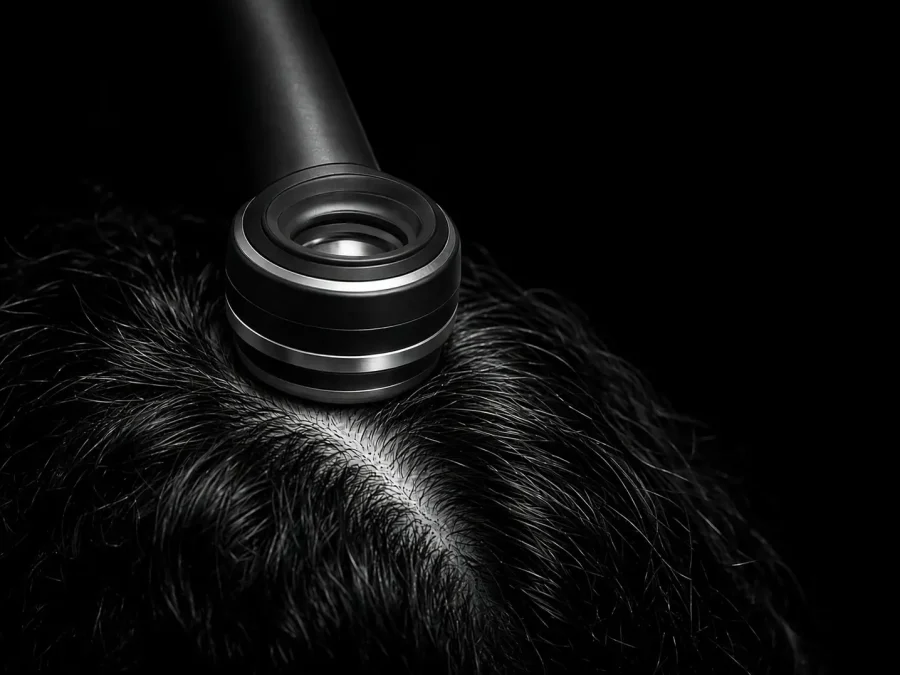
- Get a baseline. A hair and scalp analysis can show early miniaturisation under magnification before it is obvious in the mirror.
- Talk to your GP or pharmacist about medical options early if you are interested in them. Licensed medicines aim to slow progression and tend to be most useful when there is more hair to keep.
- Look after your scalp consistently. Our protocol for pattern thinning combines a weekly scalp-preparing mask, alternating shampoos and PROALOPEX+ as the core leave-in, used daily or 5 times a week for 12 weeks and then 3 times a week, over a programme of around 11 months. The full routine is in our male pattern baldness guide. These are cosmetics: they cannot change your genes, but they support a healthier-looking scalp and help hair look fuller and denser.
Our shampoos, conditioners and masks are made with the TFD System; the leave-in serums have their own formulas without exosomes.
Your questions answered
Does male pattern baldness come from the mother?
Partly. A key gene, the androgen receptor gene, is on the X chromosome, which men inherit from their mother. But large UK studies have found hundreds of other variants on chromosomes inherited from both parents, which together explain more of the risk.
Should I look at my maternal grandfather?
He is a useful clue, because your X chromosome came through your mother and may be his. But you should look at both sides of the family, including your father, brothers and uncles.
Does baldness skip a generation?
Not in any predictable way. Because many genes are involved, pattern hair loss can appear in any generation, and brothers can have very different hair.
If my father is bald, will I go bald?
Your chances are higher, but it is not certain. You inherit only half of your father’s genes, and your mother’s side contributes too. Watching for early signs is more useful than guessing.
Can women inherit pattern hair loss too?
Yes. Female pattern hair loss also has a genetic component, though it usually shows as thinning along the parting rather than a receding hairline. See our guide to female hair loss.
Sources
- Hillmer AM et al. Genetic variation in the human androgen receptor gene is the major determinant of common early-onset androgenetic alopecia. American Journal of Human Genetics 2005.
- Hagenaars SP et al. Genetic prediction of male pattern baldness. PLoS Genetics 2017.
- Pirastu N et al. GWAS for male-pattern baldness identifies 71 susceptibility loci explaining 38% of the risk. Nature Communications 2017.
- Heilmann-Heimbach S et al. Meta-analysis identifies novel risk loci and yields systematic insights into the biology of male-pattern baldness. Nature Communications 2017.
- Gatherwright J et al. The contribution of endogenous and exogenous factors to male alopecia: a study of identical twins. Plastic and Reconstructive Surgery 2013.
- British Association of Dermatologists. Hair loss – male pattern (androgenetic alopecia), patient information leaflet. Updated June 2024.
- Alopecia UK. Pattern hair loss. Updated 6 February 2026.
This article is for general information and does not replace advice from your GP, pharmacist or another health professional. SIMONE TRICHOLOGY products are cosmetics, not medicines: they do not diagnose or correct male pattern hair loss or any other medical condition. If you are worried about your hair loss, please speak to your GP.