










The quick answer: almost every man’s hairline moves back a little between his late teens and late twenties. That is a mature hairline: it rises evenly, by roughly a finger’s width, and then stays put. A receding hairline keeps moving – usually faster at the temples, creating a deepening “M” – and the hairs at the front become finer and lighter. The most reliable way to tell the two apart is to compare clear photos taken a year or more apart and to look closely at the quality of the hairs along the edge. If it is still moving, it is worth getting assessed sooner rather than later.
“Is my hairline receding?” is one of the questions I hear most from men in their twenties, and the data says they are not alone. In a 2026 survey of 2,000 UK men, 55% said they were worried about their hairline receding – 71% among Gen Z – and 65% of 18–24-year-olds said their hairline was likely to affect their confidence. On Google Trends, UK searches comparing a widow’s peak with a receding hairline, and asking how to know if your hairline is receding, have risen sharply over the past three months. This article answers those questions. For the bigger picture of pattern hair loss, start with our guide to male pattern baldness.
What is a mature hairline?
As boys we have a low, rounded “juvenile” hairline that sits close to the brows. During the late teens and twenties it usually rises slightly and takes on a more defined adult shape, often with a little recession at the temples. On the Norwood scale used by clinicians, this corresponds roughly to stage 2, which is generally regarded as normal rather than as hair loss.
Three things mark a mature hairline out:
- It moves once, then settles. Photos from two or three years ago look much the same as today.
- It is fairly even. A slight dip at each temple is normal; deep, sharp corners are not.
- The hair behind it stays strong. The hairs at the edge are as thick and dark as those further back.
What is a receding hairline?
A receding hairline is usually the first visible sign of male pattern hair loss (androgenetic alopecia). In genetically sensitive follicles, the hormone DHT gradually shortens the growth phase and shrinks the follicle, so each new hair is finer, shorter and paler than the last – a process called miniaturisation. The British Association of Dermatologists describes a receding frontal hairline and loss of hair from the top of the head as the usual pattern, with the sides and back spared.
Unlike maturation, recession keeps going. It is usually slow – years rather than months – but it does not settle on its own, and the earlier it starts, the faster it tends to progress.
Mature, receding or widow’s peak? A side-by-side guide
| Feature | Mature hairline | Receding hairline | Widow’s peak |
|---|---|---|---|
| Shape | Even, slightly higher, small dip at the temples | Deepening “M” as the temples move back faster than the centre | A natural V-shaped point in the middle of the hairline |
| Over time | Moves once in the late teens or twenties, then stable | Keeps moving back over the years | Present from early on; can look more obvious as the temples rise |
| Hairs at the edge | Thick and pigmented, like the rest | Finer, shorter, lighter “wispy” hairs | Normal thickness |
| Crown | Unaffected | May thin too | Unaffected |
| What to do | Nothing needed – keep an eye on it | Get it assessed and plan early | Nothing needed – unless the temples are clearly receding behind it |
A widow’s peak is an inherited hairline shape, not a sign of balding in itself. It can, however, become more prominent when the temples recede on either side of it – which is why the two are so often confused.
How to check your own hairline at home
- Do the finger test. Raise your eyebrows and find the highest forehead crease. A rule of thumb many clinicians use is that a mature hairline sits about one finger’s width (roughly 1–1.5 cm) above that crease. Noticeably higher than that, especially at the temples, makes recession more likely. It is a rough guide only – faces and foreheads vary.
- Compare photos. Dig out clear photos from two, three and five years ago, taken with your hair pushed back. This is far more reliable than the mirror, which you see every day.
- Look at the hairs, not just the line. In good daylight, look at the edge of your hairline. Are there lots of short, fine, see-through hairs mixed in? Those miniaturised hairs are the hallmark of pattern loss.
- Check the crown. Ask someone to photograph the top of your head from above. Thinning at the crown alongside temple recession points strongly to a pattern – see our guide to a thinning crown.
- Think about family. A strong family history makes pattern loss more likely, on either side. Our article on whether baldness is genetic explains why “it comes from your mother” is only half the story.
- Start a photo log. Take the same photos – front, both temples and crown – in the same light every three to six months. That gives you, and anyone who assesses you, real evidence.

Is it always male pattern hair loss?
Most receding hairlines in men are pattern loss, but not all. Other causes to keep in mind:
- Traction or friction. Tight braids, man buns, ponytails or helmets and headbands that rub the same spot every day can thin the hair at the front and temples. Our protocol for friction-related thinning starts with removing or reducing the pull, then uses DNA Hairmax Pro Plus daily or 5 times a week for 8–12 weeks, then 3 times a week, focusing on the hairline and the edges of the affected area.
- Shedding on top of a pattern. A bout of telogen effluvium after an illness, stress or rapid weight loss can make the hairline look suddenly worse. (Gym supplements are often blamed too – our article on creatine and hair loss looks at the evidence.)
- Scarring conditions. A shiny, smooth band of skin along the hairline, redness, itching or loss of eyebrows needs a GP or dermatologist rather than a shop-bought product.
See your GP if the change is fast, patchy, sore or itchy, or comes with other symptoms.
What you can do if your hairline is receding
1. Get it assessed early
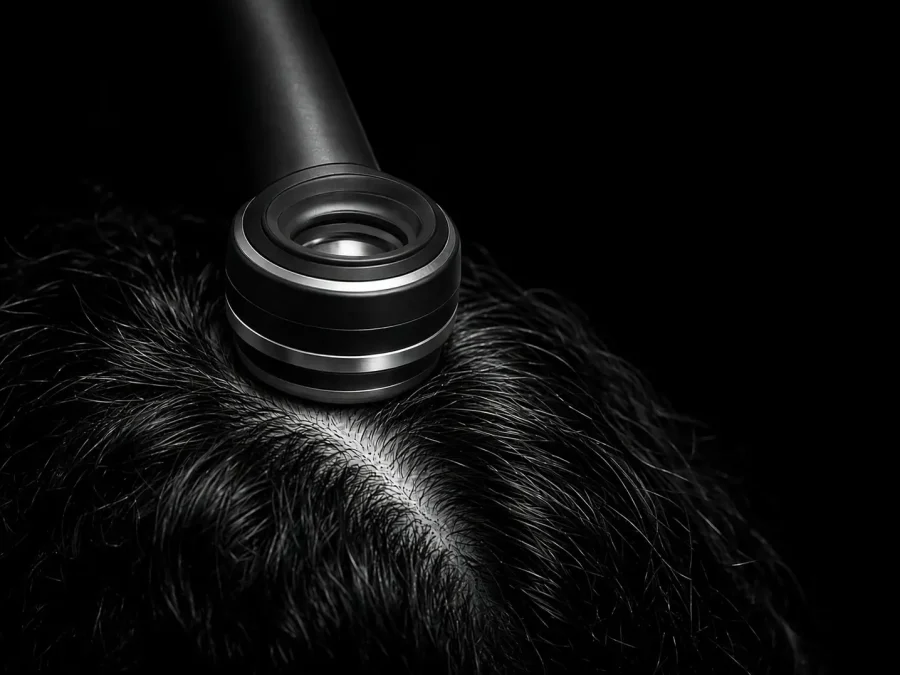
A trichologist can look at the hairline under magnification and measure density, which is much more precise than the mirror. A hair and scalp analysis also gives you a baseline to compare against later.
2. Understand the medical options
Licensed medicines – minoxidil from pharmacies and finasteride on prescription – aim to slow progression; they do not suit everyone and only work while they are used. The MHRA has asked prescribers and patients to be alert to psychiatric and sexual side effects with finasteride. Our male pattern baldness guide covers these in more detail, and your GP or pharmacist can advise on whether they are right for you.
3. Follow a consistent scalp-care routine
For pattern thinning, our usage protocol prepares the scalp once or twice a week with Dermo Capillary Mask Activated Plus in micro-peel mode (massage 1–2 minutes, leave 3–5 minutes, rinse), then washes 3–4 times a week alternating Hair Loss Prevention Shampoo Plus and Hair Nutrient Royal Jelly Shampoo Plus (massage 1–2 minutes, leave 2–3 minutes, rinse). The core leave-in is PROALOPEX+, daily or 5 times a week for 12 weeks and then 3 times a week, applied in sections and including the temples; for early to moderate thinning with an oily scalp, AGA Cellular Therapy Plus can be added on the same schedule for 8–12 weeks. The full programme runs for around 11 months and is set out in the pillar guide.
Our shampoos, conditioners and masks are made with the TFD System; the leave-in serums have their own formulas without exosomes. These products are cosmetics: they cannot change your genes, but they support a healthier-looking scalp and help hair along the hairline look fuller and denser.
4. Choose a haircut that works with it
UK searches for “French crop receding hairline” have rocketed this autumn, and for good reason. Styles that usually flatter a receding hairline include:
- A textured French crop, with a short, slightly forward fringe that softens the corners;
- A short, textured crop or quiff, rather than slicking hair straight back, which exposes the temples;
- A buzz cut, which reduces the contrast between thicker and thinner areas;
- Shorter sides, so the top does not look sparse by comparison.
Growing your fringe long to hide the temples usually backfires as the hair gets finer. A good barber is one of your best allies here.
Your questions answered
How do I know if my hairline is receding or maturing?
A mature hairline rises evenly by roughly a finger’s width above your top forehead crease and then stays put. A receding hairline keeps moving back, especially at the temples, and the hairs at the edge become finer. Comparing photos from a few years apart is the most reliable test.
Is a receding hairline at 20 normal?
Some change at 20 is normal, because the hairline is still maturing. But pattern hair loss can also start in the late teens or early twenties, and an early start tends to progress faster. If the temples are clearly deepening or the edge hairs look wispy, get it assessed.
What is the difference between a widow’s peak and a receding hairline?
A widow’s peak is an inherited V-shaped point in the middle of the hairline and is not a sign of balding. A receding hairline is progressive loss at the temples. The peak can look more pronounced if the temples recede around it.
Can a receding hairline be slowed?
Licensed medicines such as minoxidil and finasteride aim to slow pattern hair loss, although they do not work for everyone and only while they are used; discuss them with your GP or pharmacist. A consistent scalp-care routine helps the hair you have look fuller and denser.
Do women get receding hairlines?
Women can, but female pattern thinning usually affects the parting and top of the head while the front hairline stays in place. Recession at the front in women is more often linked to tight hairstyles or other conditions, so it is worth seeing a GP or trichologist – see our guide to female hair loss.
Sources
- British Association of Dermatologists. Hair loss – male pattern (androgenetic alopecia), patient information leaflet. Updated June 2024.
- Alopecia UK. Pattern hair loss. Updated 6 February 2026.
- Norwood OT. Male pattern baldness: classification and incidence. Southern Medical Journal 1975.
- MHRA. Drug Safety Update: finasteride – psychiatric and sexual side effects. 29 April 2024.
- City Skin Clinic. Mature hairline vs receding – what’s the difference? November 2025.
- Elithair / Censuswide. UK Hair Confidence Report 2026.
- NHS. Hair loss.
This article is for general information and does not replace advice from your GP, pharmacist or another health professional. SIMONE TRICHOLOGY products are cosmetics, not medicines: they do not diagnose or correct male pattern hair loss or any other medical condition. If you are worried about your hairline, please speak to your GP.