



The quick answer: yes, some people notice more hair in the brush or the plughole a few months after starting a weight-loss jab such as Mounjaro (tirzepatide) or Wegovy (semaglutide). In most cases this is temporary, diffuse shedding (telogen effluvium) triggered by losing weight quickly and eating much less, rather than lasting damage to the follicles. It usually shows up 2–4 months after the weight starts coming off and settles over the following months once your weight and eating pattern stabilise. Eating enough protein and iron, being gentle with your hair and following a consistent scalp-care routine all help your hair look its best in the meantime. Never stop or change your medicine because of your hair without speaking to your prescriber.
Weight-loss jabs have become part of everyday life in the UK. Market research quoted by Cosmetics Business in October 2026 suggests the share of British households using a GLP-1 medicine rose from 2.3% in 2024 to 6.3% in 2026 – and in clinic I now hear the same question every week: “Is my hair falling out because of the jab?” This guide explains why it happens, how common it is, who is most likely to notice it, what it looks like and what you can do to look after your hair and scalp while you lose weight.
It is the hub of a short series. For more detail, read our guides to the Mounjaro hair loss timeline, protein, iron and eating for your hair while losing weight, a hair-care routine for weight-loss jabs and GLP-1 medicines and male pattern hair loss.
Why can weight-loss jabs affect your hair?
GLP-1 medicines (and dual GLP-1/GIP medicines such as tirzepatide) reduce appetite and slow down how quickly the stomach empties. People eat less and lose weight – sometimes a lot of weight, quite quickly. Three things seem to be involved in hair changes, and they often overlap.
1. Rapid weight loss upsets the hair cycle
Each hair goes through a long growing phase (anagen), a short transition and a resting phase (telogen) before it is shed. A sudden physical stress – an operation, a high fever, having a baby or losing weight fast – can push many more follicles than usual into the resting phase at the same time. Around two to three months later, those hairs are released together. This is called telogen effluvium, and it is the pattern most often described with weight-loss jabs. The BMJ noted in July 2026 that shedding typically begins 2–4 months after significant weight loss.
2. Eating much less can leave hair short of building blocks
Hair is made mostly of keratin, a protein, and growing follicles are among the busiest cells in the body. When appetite drops sharply, protein, iron, zinc and overall calories can all fall below what your body needs. Hair is not essential for survival, so it is one of the first places to show it. Our guide to protein and iron for hair while losing weight covers this in detail.
3. Is it the medicine itself?
This is still being studied. Hair loss is now listed as a possible side effect in the UK product information for tirzepatide (Mounjaro), and recent research has looked for a direct effect:
- A large BMJ study (July 2026) of adults with type 2 diabetes found more new cases of alopecia among people starting a GLP-1 medicine than among people starting two other types of diabetes medicine. Experts commenting on it pointed out that it could not fully separate the medicine from the weight loss.
- A genetic study in the Journal of Investigative Dermatology (September 2026) linked GLP-1 activity with slightly higher odds (about 7%) of male pattern hair loss. The authors said the clinical relevance is uncertain – see GLP-1 medicines and hair loss in men.
The honest summary: for most people, the speed of weight loss and the drop in food intake explain the shedding well. Whether the medicines also have a small direct effect on follicles is an open question.
How common is hair loss on weight-loss jabs?
Figures vary with the medicine, the dose, how much weight people lose and how the information was collected. These are the numbers published so far:
| Source | What was measured | Result |
|---|---|---|
| US prescribing information for tirzepatide for weight management (via Drugs.com) | Hair loss by sex | 7.1% of women vs 0.5% of men (about 1% with placebo) |
| US prescribing information for semaglutide 2.4 mg (via Drugs.com) | Hair loss reported as a side effect | 3% vs 1% with placebo |
| BMJ target trial emulation, July 2026 (adults with type 2 diabetes) | New alopecia diagnoses per 1,000 person-years | 6.91 with GLP-1 medicines vs 5.04 and 3.89 with two other diabetes medicines |
| Survey quoted by The Guardian, September 2026 | People reporting shedding | About 1 in 5 |
In short, most people on a weight-loss jab do not notice significant hair changes, but a meaningful minority do – and women report it far more often than men.
Who is most likely to notice it?
- Women. Trials and reviews consistently show more hair shedding reported by women. Many are also in their 40s and 50s, when hormonal changes already affect hair – see our guides to female hair loss and menopause hair thinning.
- People losing weight quickly. The faster and larger the weight loss, the stronger the signal to the hair cycle.
- People eating very little. Skipped meals, low protein and very low calorie intake add to the stress.
- People with pattern thinning already in the family. A bout of shedding can make existing thinning at the crown, parting or temples more visible.
- People with low iron or vitamin D, or a thyroid problem. These can cause shedding on their own and are worth checking with your GP.
What does jab-related hair loss look like?
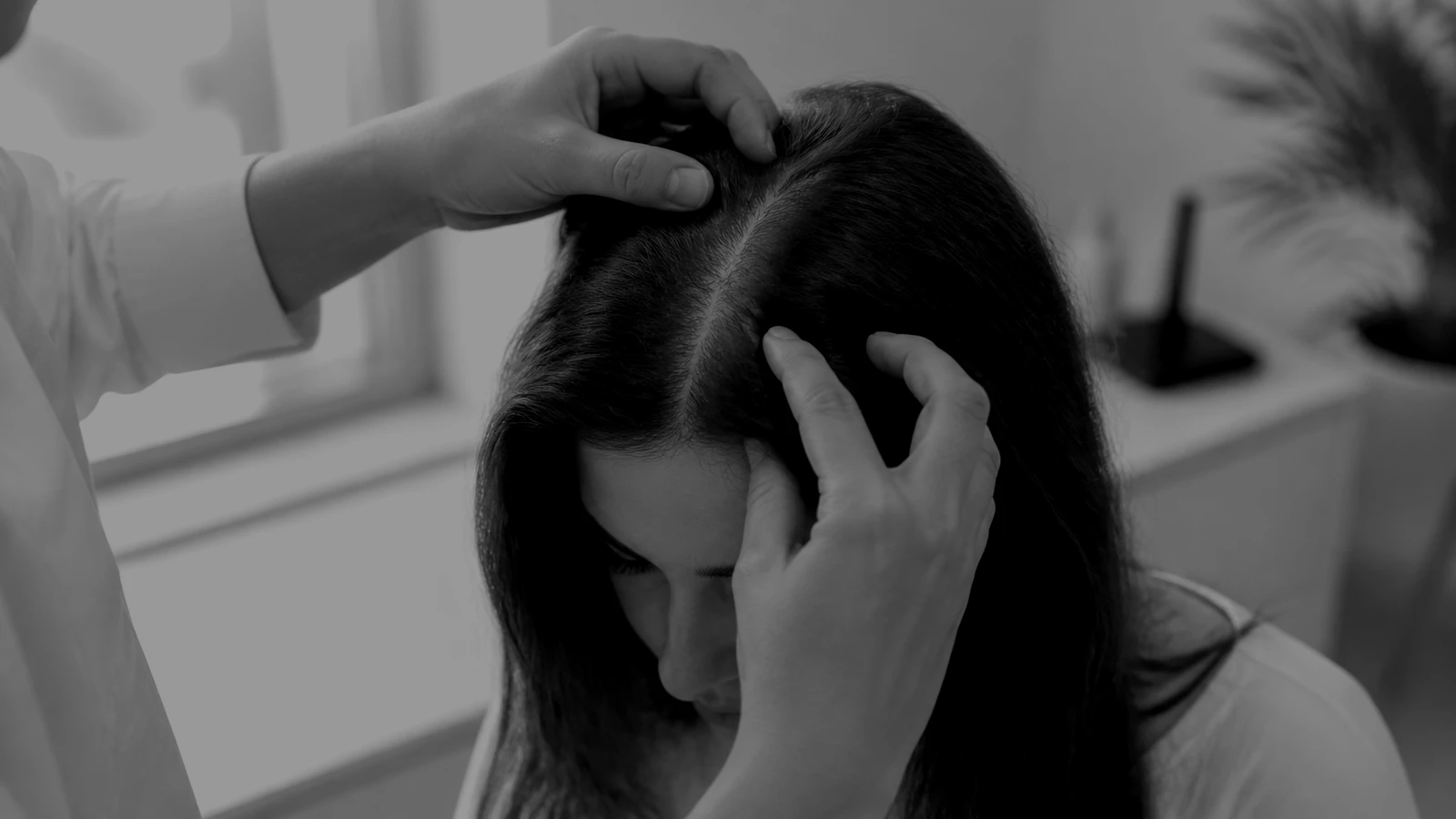
Most people describe more hairs than usual in the shower, on the pillow and in the brush, with hair feeling thinner overall and the ponytail feeling smaller. The scalp usually looks normal. It helps to compare it with other patterns – our guide to hair shedding vs hair loss explains the difference in more depth.
| What you notice | Likely pattern | What it usually means |
|---|---|---|
| Lots of hairs falling from all over the head, starting 2–4 months after the weight loss began | Diffuse shedding (telogen effluvium) | Usually temporary; settles once weight and eating stabilise |
| A wider parting, a see-through crown or receding temples that keep getting gradually more noticeable | Pattern thinning (androgenetic alopecia), sometimes unmasked by shedding | Long-term and gradual; worth a proper assessment |
| Round, smooth bald patches | Patchy hair loss (alopecia areata) | Not typical of weight loss; see your GP |
| Short, broken hairs, dryness and split ends | Breakage | A hair-fibre issue rather than a root issue – see why hair breaks |
How long does it last?
Diffuse shedding linked to weight loss typically starts 2–4 months after the weight loss begins, is most noticeable for a few weeks to a few months and then gradually settles. Because hair grows about a centimetre a month, it takes longer still – often six months or more – before your hair looks as full as it did. Our Mounjaro hair loss timeline goes through this month by month, including what to expect if you stop the medicine.
Look after your hair from the inside
The single most useful thing you can do is make sure that eating less does not mean eating badly. Practical priorities:
- Protein at every meal. Eggs, fish, chicken, Greek yoghurt, tofu, beans and lentils. When appetite is small, eat the protein part of the plate first.
- Iron-rich foods. Red meat in moderation, pulses, dark green vegetables and fortified cereals, ideally with a source of vitamin C.
- Vitamin D in autumn and winter, as the NHS advises for everyone in the UK.
- Do not self-prescribe high-dose supplements. Ask your GP for a blood test if you are worried about iron, vitamin D or thyroid function.
Our full guide to protein for hair while losing weight includes simple meal ideas for small appetites, and our article on how food affects your hair covers the wider picture.
A scalp-care routine while your hair is shedding
A cosmetic routine will not change what a medicine does inside your body, but it can keep the scalp comfortable and balanced, reduce breakage and help your hair look fuller and denser while the hair cycle settles. In clinic I use the same three steps as in all SIMONE TRICHOLOGY programmes:
- Prepare (1–2 times a week): Dermo Capillary Mask Activated Plus in micro-peel mode on the scalp for 3–5 minutes before washing.
- Wash (3–4 times a week): alternate Hair Loss Prevention Shampoo Plus and Hair Nutrient Royal Jelly Shampoo Plus. Massage for 1–2 minutes and leave on for 2–3 minutes. Like all our shampoos, conditioners and masks, they use The biomimetic exosomes in the TFD System.
- Leave-in: a scalp serum chosen for what your hair is doing (table below), applied to a clean scalp in sections and massaged in without rinsing.
| What your hair is doing | Leave-in serum | Intensive phase | Then |
|---|---|---|---|
| Sudden, diffuse shedding a few months after the weight started coming off | Dixidox Forte Advance Plus | Morning and evening for 10 days | Once a day or 3–5 times a week for 6–8 weeks |
| Very heavy shedding (“shock” option) | PROSCIENCE+ | Morning and evening for 10 days | Once a day or 3–5 times a week for 6–8 weeks |
| Gradual, all-over thinning | DNA Hairmax Pro Plus | Daily or 5 times a week for 8–12 weeks | 3 times a week |
| Thinning that coincides with the menopause | Royal Jelly Hair Activator Plus | Daily or 5 times a week for 8–12 weeks | 3 times a week |
| Pattern thinning at the crown, parting or temples that the shedding has made more visible | PROALOPEX+ | Daily or 5 times a week for 12 weeks | 3 times a week, as part of a programme of around 11 months |
The step-by-step version, with tips for washing, drying and styling gently, is in our guide to a hair-care routine for weight-loss jabs. If you want to add body to fine hair on top of this, a volumising shampoo such as Volume Therapy Shampoo Plus is an optional extra rather than part of the core routine.
Not sure which programme suits you? Send three photos to our free online Hair Clinic for a personalised assessment, or browse the Thinning Hair & Hair Loss Care range.
What about men?
Men report diffuse shedding on weight-loss jabs much less often than women, but a recent genetic study raised a different question: whether GLP-1 activity might nudge male pattern hair loss. The effect it found was small and its real-world meaning is unclear. We look at the evidence, and at what men who are already thinning can do, in GLP-1 medicines and male pattern hair loss.
Should you stop the jab because of your hair?
Not without talking to the person who prescribed it. Weight-loss medicines are prescription-only for good reasons, and the decision to continue, pause or change the dose depends on your overall health, not just your hair. Shedding linked to weight loss is usually temporary, and stopping suddenly does not make it settle any faster. Tell your prescriber or GP what you are noticing – they may review your dose, how quickly you are losing weight and whether you are eating enough.
When to see your GP
Speak to your GP if your shedding is very heavy or carries on for more than six months, if you notice bald patches, a red, sore, scaly or scarred scalp, or if you also feel unusually tired, cold, breathless or low. Your GP can check iron stores, vitamin D, thyroid function and other causes and refer you to a dermatologist if needed. If you are on a weight-loss medicine, mention it.
Your questions answered
Do weight-loss jabs cause hair loss?
Some people notice more shedding a few months after starting a weight-loss jab such as Mounjaro or Wegovy. In most cases it is temporary, diffuse shedding (telogen effluvium) triggered by losing weight quickly and eating much less. Whether the medicines also have a small direct effect on hair follicles is still being studied.
How common is hair loss on Mounjaro or Wegovy?
In US prescribing information, hair loss was reported by 3% of adults on semaglutide 2.4 mg compared with 1% on placebo, and by 7.1% of women and 0.5% of men on tirzepatide for weight management. Most people do not notice significant changes, but women report it far more often than men.
When does hair loss from weight-loss jabs start and stop?
It usually starts 2–4 months after the weight begins to come off, is most noticeable for a few weeks to a few months and then settles as your weight and eating pattern stabilise. Hair grows about a centimetre a month, so looking as full as before can take six months or more.
Is hair loss from weight-loss jabs permanent?
Usually not. Shedding linked to rapid weight loss is a temporary shift in the hair cycle, and the follicles go on to form new hairs. It can, however, make existing pattern thinning more visible, and pattern thinning is long-term – so if your parting, crown or temples keep changing, get it assessed.
Why are women more affected by jab-related hair loss?
Trials and reviews consistently find more shedding reported by women. Many are also in their 40s and 50s, when hormonal changes, including the menopause, already affect the hair, and iron stores are more often low in women who have periods.
What can I do about hair shedding on a weight-loss jab?
Eat enough protein and iron, take vitamin D in autumn and winter as the NHS advises, be gentle with styling and follow a consistent scalp-care routine. For shedding that starts a few months after the weight starts coming off, our protocols use Dixidox Forte Advance Plus morning and evening for 10 days, then once a day or 3–5 times a week for 6–8 weeks, with Hair Loss Prevention Shampoo Plus and Hair Nutrient Royal Jelly Shampoo Plus.
Should I stop my weight-loss injection if my hair is falling out?
Not without talking to your prescriber. Shedding linked to weight loss is usually temporary and stopping suddenly does not make it settle faster. Your prescriber or GP can review your dose, how quickly you are losing weight and whether you are eating enough.
Sources
- NHS. Hair loss.
- NHS Specialist Pharmacy Service. Revised SPC: Mounjaro (tirzepatide) solution for injection in pre-filled pen.
- Tang H, et al. Target trial emulation of hair loss risk with GLP-1 receptor agonists in adults with type 2 diabetes. BMJ, 22 July 2026. doi:10.1136/bmj-2026-100077. Science Media Centre expert reaction.
- BMJ. Does Mounjaro cause hair loss? 29 July 2026.
- Ramessur R, Spindler A, et al. A causal effect of increased GLP1R expression on male-pattern hair loss is suggested by 2-sample Mendelian randomization. J Invest Dermatol 2026. doi:10.1016/j.jid.2026.07.024.
- The Guardian. GLP-1s and hair loss. 27 September 2026.
- Cosmetics Business. Feature on hair-loss care and GLP-1 use in the UK, 26 October 2026.
- Drugs.com. Do Ozempic, Wegovy, Mounjaro & Zepbound cause hair loss? (summary of US prescribing information).
- NHS. Vitamin D.
This article is for general information and does not replace advice from your doctor or pharmacist. SIMONE TRICHOLOGY does not sell or recommend weight-loss medicines. SIMONE TRICHOLOGY products are cosmetics and are not intended to diagnose, treat or prevent any medical condition. If your hair loss is sudden, patchy or worrying you, please speak to your GP or a dermatologist.