

The quick answer: seborrhoeic dermatitis usually causes softer, greasy or yellowish flakes on a pink or red (or darker) scalp with blurred edges, often with flaking in the eyebrows, beside the nose and around the ears. Scalp psoriasis usually causes thicker, raised plaques with sharp edges and silvery-white scale, often spreading just past the hairline or behind the ears, and sometimes with patches on the elbows or knees and dents in the nails. Dandruff is the mild end of seborrhoeic dermatitis, with flakes but little redness; a dry scalp gives small, powdery flakes on a tight, non-red scalp. Some people have features of both conditions, so if you are unsure – or nothing is helping after four weeks – see your GP.
“Is it psoriasis or seborrhoeic dermatitis?” is one of the most common questions I am asked, and “vs psoriasis” is one of Google’s top UK suggestions when people search for seborrhoeic dermatitis. It matters, because the two respond to slightly different care and psoriasis can affect much more than the scalp. This guide puts them side by side, adds dandruff and dry scalp into the picture, and explains how each is looked after. For the full picture of seborrhoeic dermatitis itself, start with our guide to seborrhoeic dermatitis on the scalp.
Side by side: the key differences
| Feature | Seborrhoeic dermatitis | Scalp psoriasis |
|---|---|---|
| Scale | Greasy, yellowish or white, soft and sticky | Thick, dry, silvery-white; can build up in layers |
| Edges | Soft and blurred | Sharp and well defined; plaques feel raised |
| Colour | Pink or red on lighter skin; darker or lighter patches on brown and black skin | Pink or red on lighter skin, turning silvery-white; grey or darker on brown and black skin |
| Where else | Eyebrows, creases beside the nose, in and behind the ears, beard area, centre of the chest | Behind the ears, elbows, knees, lower back, nails (dents and pits) |
| How it feels | Itchy; scalp often feels oily | Itchy and sometimes sore or tight; can crack and bleed |
| Typical age | Often 30–40 in adults (also cradle cap in babies) | Often starts at 15–25 or 50–60 |
| Underlying cause | Reaction to Malassezia yeast, sebum and a reactive skin barrier | An immune-driven condition with a strong family tendency |
Sources: British Association of Dermatologists (seborrhoeic dermatitis) and NHS (psoriasis). These are general patterns – real scalps don’t always read the textbook.
Where do dandruff and dry scalp fit in?
Dandruff and a dry scalp are the two milder lookalikes, and between them they account for most flaky scalps:
- Dandruff is, according to the British Association of Dermatologists, the scalp form of seborrhoeic dermatitis at its mildest: flakes, perhaps an itch, but no obvious redness or soreness. Our guide to dry vs oily dandruff explains the two types.
- A dry scalp gives fine, white, powdery flakes on a scalp that feels tight rather than greasy. It is common in winter and with very hot water or harsh shampoos. Read more in our article on dry dandruff.
The NHS dandruff page also lists other conditions that can look similar: scalp ringworm (a red or silvery rash, sometimes with patchy hair loss – common in children), eczema, and contact dermatitis, a reaction to hair dye, sprays, gels or mousses that can cause red, irritated, sometimes blistered skin. If you have recently changed products or coloured your hair, mention it to your GP or pharmacist.
When it’s a bit of both
Some people have features of both conditions – greasy scale in one place, thicker plaques in another, or patches that change over time. Dermatologists sometimes describe this overlap as “sebopsoriasis”. It is one of the reasons self-diagnosis from photos online is unreliable, and why a professional look is worthwhile if things are not settling.
How a professional tells them apart
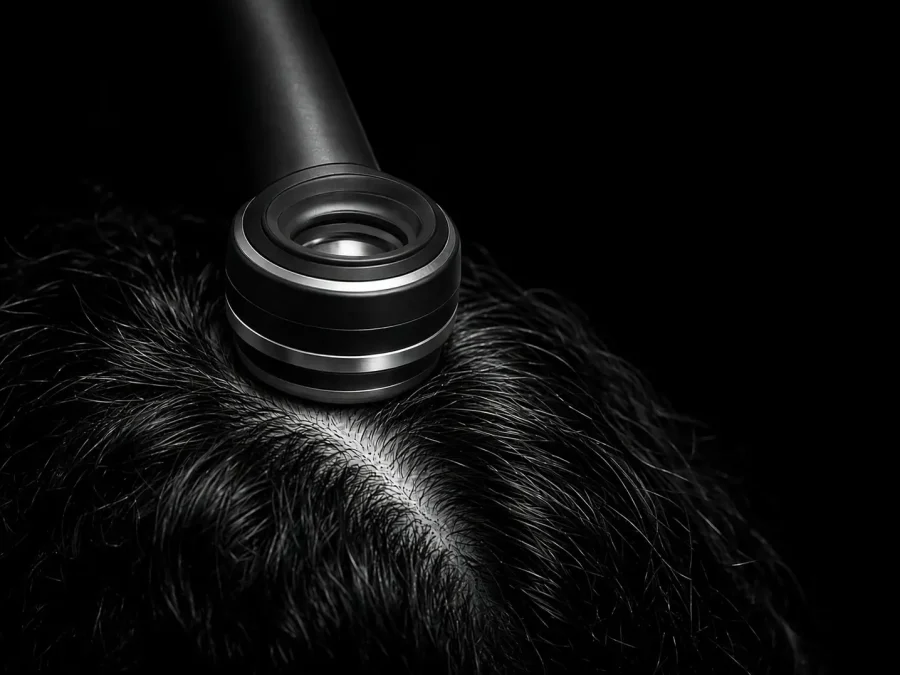
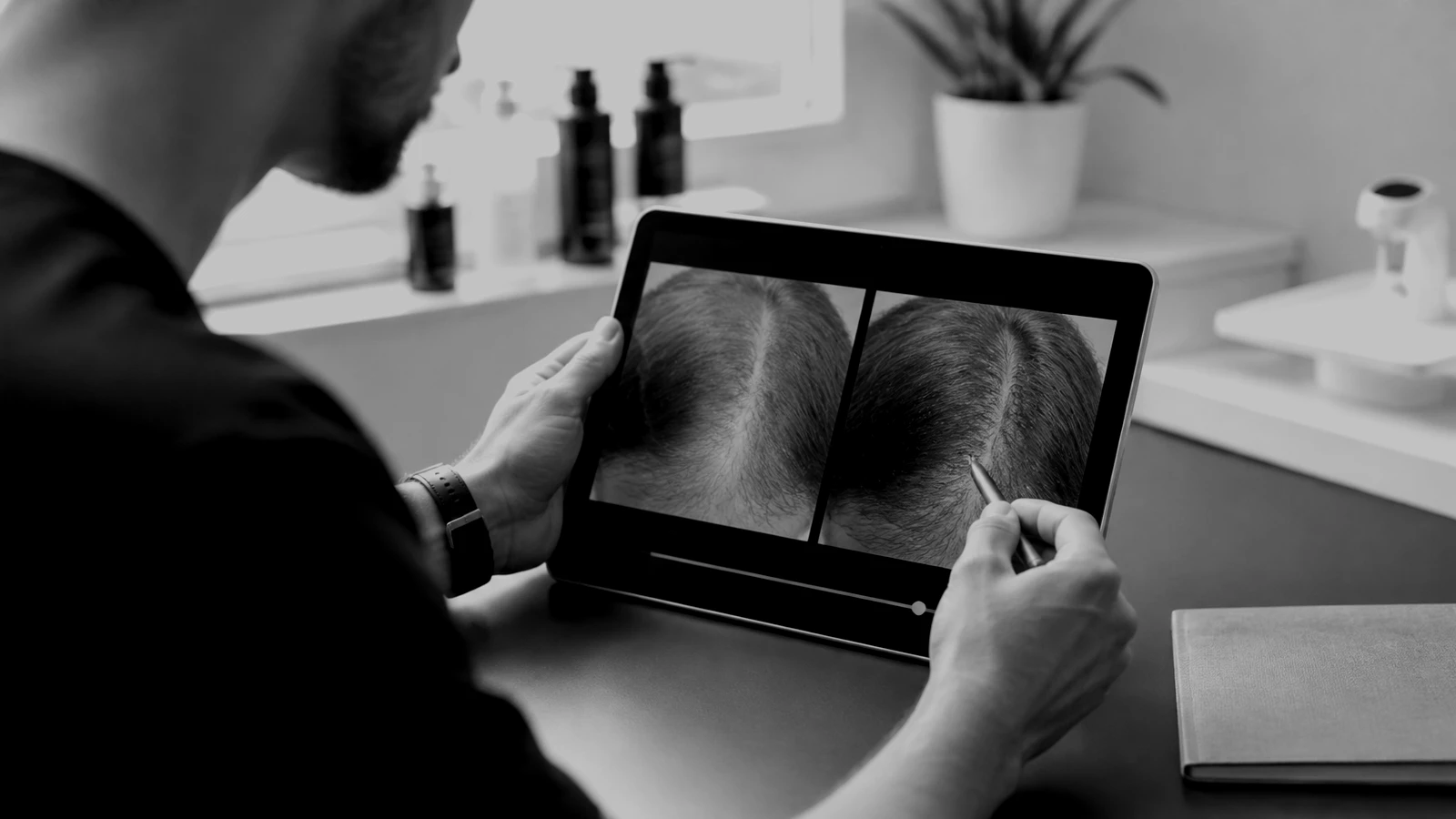
Most of the time, the difference is clear from looking carefully at the scalp, the hairline, the face, the ears, the elbows and knees and the nails, and from asking how long it has been there and what makes it worse. In a trichology consultation we also use a magnified scalp camera (trichoscopy) to look at the scale, the blood vessels and the follicles – our guide to trichoscopy and scalp analysis explains what it shows. If there is any doubt, a GP or dermatologist may take skin scrapings to rule out a fungal infection, or occasionally a small skin sample.
How each is looked after
Both are long-term conditions that come and go. Your GP or pharmacist can advise on medicated options – for seborrhoeic dermatitis these are usually antifungal shampoos, sometimes with a short course of a steroid scalp lotion; for scalp psoriasis they include coal tar shampoos, steroid scalp applications and preparations to soften thick scale. Alongside that, our trichology protocols set out cosmetic routines for each scalp type:
| Step | Scalp prone to seborrhoeic dermatitis | Scalp prone to psoriasis | Dry, flaky scalp |
|---|---|---|---|
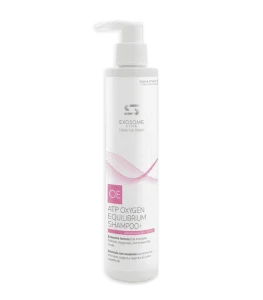
| Prepare (1–2 times a week, before washing) | Dermo Capillary Mask Activated Plus, micro-peel mode, 3–5 minutes (2–3 if sensitive) | Same mask, 3–5 minutes (2–3 if sensitive); do not apply to open or bleeding areas | Same mask, 3–5 minutes (2–3 if sensitive) |
| Wash | At least 3 times a week, alternating Dandruff & Scalp Care Shampoo Plus and Sebum Control Shampoo Plus | At least 3 times a week, alternating Dandruff & Scalp Care Shampoo Plus and Nutri Fiber Moisturizing Shampoo Plus; lukewarm water, gentle massage | Daily or 3–4 times a week, alternating Dandruff & Scalp Care Shampoo Plus and Nutri Fiber Moisturizing Shampoo Plus |
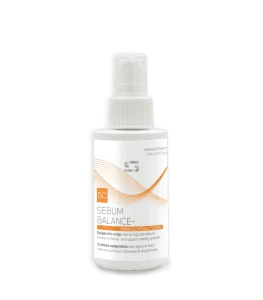
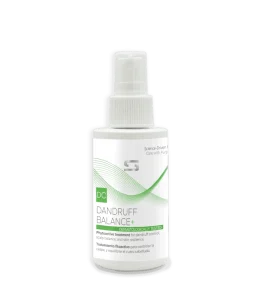
| Leave-in | Sebum Balance Plus (day 1) and Dandruff Balance Plus (day 4–5), twice a week for 90 days | Dandruff Balance Plus 4 times a week for 90 days, then 3–4 times a week as needed | Dandruff Balance Plus daily in the intensive phase, then 3–4 times a week |
In every case, massage each shampoo into the scalp for 1–2 minutes and leave it for 2–3 minutes before rinsing. The shampoos and the mask use the biomimetic exosomes in the TFD System; the leave-in concentrate has its own formula without exosomes. If you are under a dermatologist’s care, these routines are cosmetic support – hygiene, comfort and a visible reduction in flaking – and do not replace your prescribed plan.
Three things not to do
- Don’t pick or scrape plaques or scale. It makes the skin sorer and, with psoriasis, can trigger new patches where the skin is injured.
- Don’t use very hot water. Lukewarm is kinder to both conditions; our protocols advise staying below about 37 °C.
- Don’t smother a greasy, flaky scalp in oil. It can help loosen thick psoriasis scale under medical advice, but on a scalp prone to seborrhoeic dermatitis oils tend to make things worse.
More in this series: why flares cluster in the colder months in seborrhoeic dermatitis in winter, how to find your personal seborrhoeic dermatitis triggers, and what to do if you are shedding more after a flare in seborrhoeic dermatitis and hair loss.
When to see your GP
See your GP if an anti-dandruff shampoo has not helped after four weeks, if the scalp is very itchy, red, swollen or sore, if you have patches on your face or body as well, if your nails are pitted or your joints are painful (psoriasis can affect the joints), or if you notice patchy hair loss. If you want help with the cosmetic side, our hair clinic can assess your scalp and suggest a routine.
Your questions answered
How can I tell scalp psoriasis from seborrhoeic dermatitis?
Seborrhoeic dermatitis usually has softer, greasy or yellowish scale with blurred edges and often affects the eyebrows, sides of the nose and ears. Scalp psoriasis tends to form thick, raised plaques with sharp edges and silvery-white scale, often with patches elsewhere such as the elbows or knees, or pitted nails. If you are unsure, see your GP.
Is seborrhoeic dermatitis the same as dandruff?
Dandruff is the mildest scalp form of seborrhoeic dermatitis: flakes without obvious redness or soreness. Once the scalp becomes red, sore or crusted, or the face is involved, it is usually called seborrhoeic dermatitis.
How do I know if it is dry scalp or dandruff?
A dry scalp gives small, white, powdery flakes on a scalp that feels tight, and it often gets worse with hot water and central heating. Dandruff flakes tend to be larger and slightly oily, and the scalp may itch more.
Can you have psoriasis and seborrhoeic dermatitis at the same time?
Yes. Some people have features of both, which dermatologists sometimes call sebopsoriasis. A GP or dermatologist can confirm what is going on and advise on the right medicated products.
Is scalp psoriasis contagious?
No. Neither scalp psoriasis nor seborrhoeic dermatitis is contagious. Psoriasis is an immune-driven condition, and seborrhoeic dermatitis is a reaction to a yeast that lives on everyone’s skin.
Sources
- British Association of Dermatologists. Seborrhoeic dermatitis: patient information leaflet (last updated January 2023).
- NHS. Psoriasis.
- NHS. Dandruff.
- Naldi L, Kyrgidis A, Tiplica GS, et al. Practical recommendations for seborrheic dermatitis management: an expert consensus. Journal of the European Academy of Dermatology and Venereology, first published 21 April 2026. doi:10.1111/jdv.70444.
This article is for general information and does not replace advice from your GP, pharmacist or dermatologist. SIMONE TRICHOLOGY products are cosmetics, not medicines: they are not intended to diagnose or address seborrhoeic dermatitis, psoriasis or any other medical condition, and they do not replace anything your doctor has prescribed. If your scalp is red, sore, weeping or not settling, or you notice patchy hair loss, please speak to your GP or a dermatologist.