
For decades, hair care has been reactive: shedding, breakage, greasy roots or flaking appears, and we look for a product to correct it. Hair longevity turns that logic around. It asks a different question: what can we do today to help the hair and scalp remain in their best possible condition for longer?
At SIMONE TRICHOLOGY, we have worked with this prevention-first mindset since 1989. This guide explains what hair longevity means, how hair and scalp change over time, what a realistic routine can achieve and where cosmetic care must give way to professional assessment.
What is hair longevity?
Hair longevity is an emerging, multifactorial approach to maintaining healthy-looking hair throughout life. It considers the hair follicle, scalp environment, visible fibre and wider health factors together rather than treating them as separate concerns.
The related term “hairspan” is sometimes used to describe the period during which hair retains desirable qualities such as density, strength, pigmentation and resilience. Neither term is a medical diagnosis or a promise that ageing or hair loss can be prevented completely.
In practical terms, hair longevity means moving:
- From correction to prevention: supporting the hair and scalp before avoidable damage becomes extensive.
- From lengths alone to scalp and follicle awareness: understanding that visible hair is the result of activity beneath the skin.
- From isolated products to consistent routines: choosing appropriate care and maintaining it over time.
- From assumptions to assessment: investigating persistent shedding, thinning or scalp symptoms instead of treating every problem in the same way.
Hair, follicles and scalp do not age in the same way
Hair ageing is not a single process. The follicle, the visible hair shaft and the scalp are different structures, and each may change for different reasons.
The hair follicle and growth cycle
Each follicle repeatedly passes through phases of active growth (anagen), transition (catagen), rest (telogen) and release of the fibre (exogen). These cycles are influenced by genetics, hormones, age, health, nutrition, medication and certain medical conditions.
With age, some people experience shorter growth phases, longer resting intervals or progressively finer fibres. Others retain stable density for many years. These changes are not identical in everyone and should not automatically be attributed to ageing, particularly when shedding is sudden, patchy or accompanied by scalp symptoms.
You can explore the underlying anatomy in our guide to hair structure and the growth cycle. For a closer look at gradual changes, see how hair ages over the years.
The visible hair fibre
The shaft outside the scalp is a biologically non-living keratin fibre. It cannot repair itself in the way living skin can. Conditioning products may improve its surface, flexibility and appearance, but accumulated structural damage cannot be biologically healed.
Friction, repeated high heat, ultraviolet exposure, bleaching, permanent colour and other chemical processes gradually weather the cuticle. This can produce roughness, loss of shine, tangling and breakage. Protecting fibre that has already grown is therefore one of the most immediate and controllable parts of a hair longevity routine.
The scalp environment
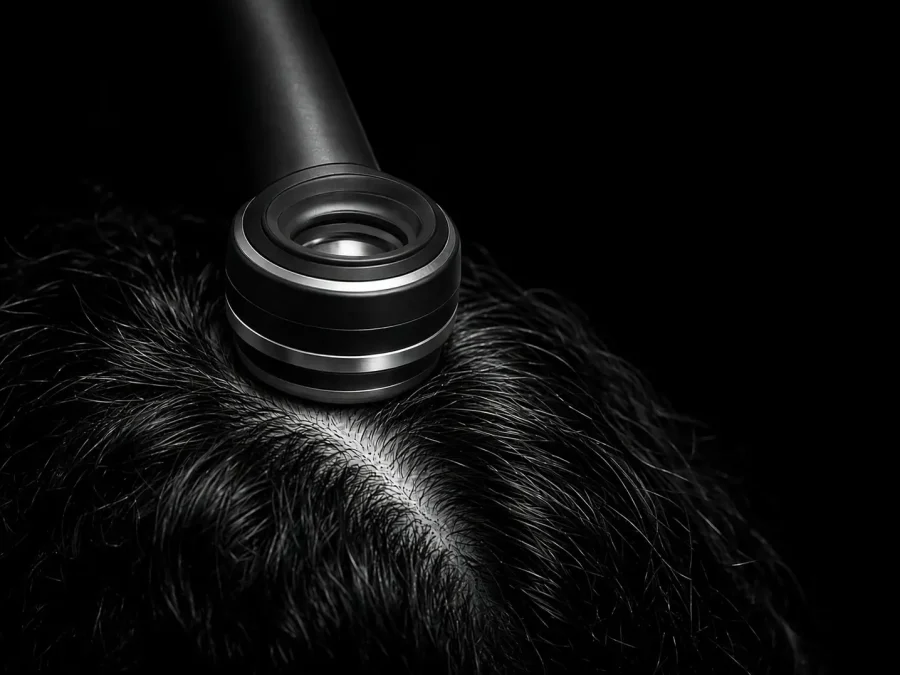
The scalp is living skin containing follicles, sebaceous glands, a protective barrier and a complex microbial ecosystem. Its oil production, hydration and sensitivity can change with age, climate, hormones, health and the products applied to it.
A comfortable, appropriately cleansed scalp provides a better environment for normal hair function. However, a “healthy scalp” cannot guarantee protection from genetic, hormonal, autoimmune or scarring forms of alopecia. Persistent inflammation, scaling, pain or itching requires proper evaluation.
The four fronts of hair longevity
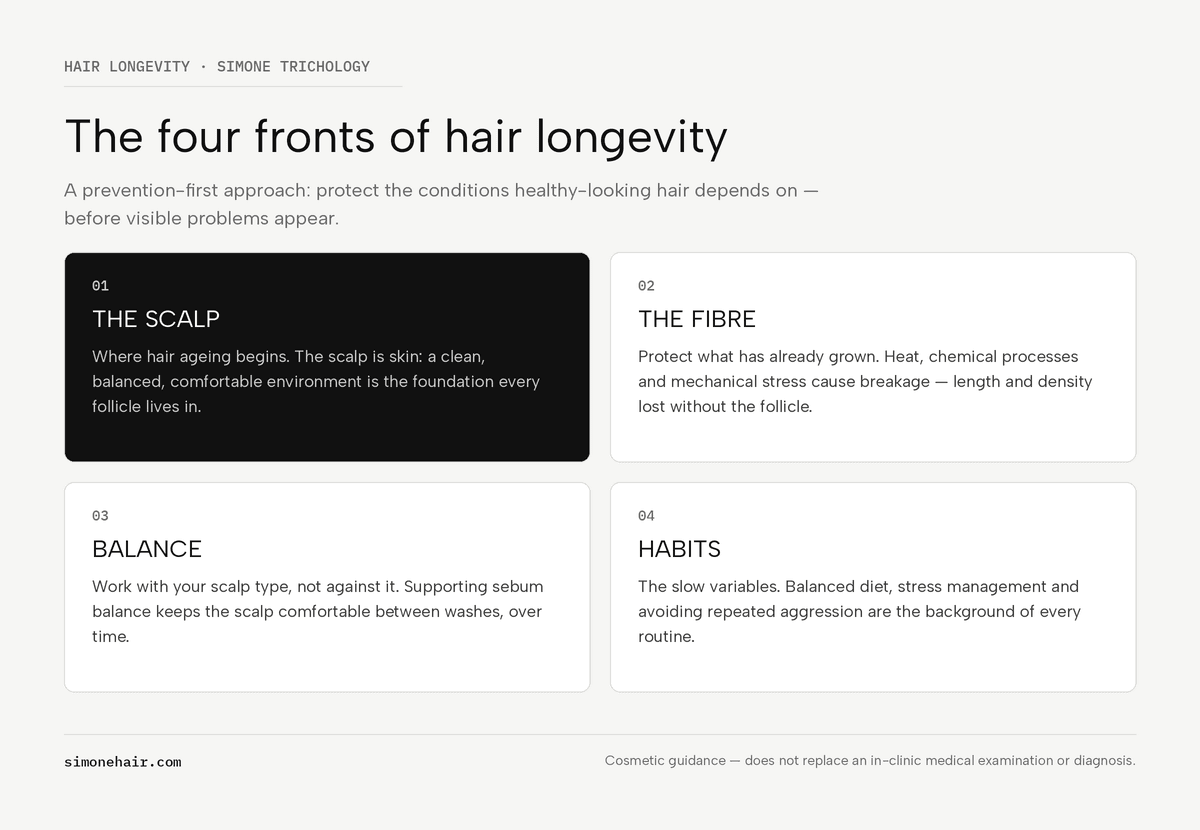
1. Scalp: maintain a suitable environment
Scalp care begins with cleansing often enough for your individual level of sebum, perspiration, styling-product use and activity. There is no washing frequency that is correct for everyone.
Use products suited to your actual scalp rather than choosing solely according to the condition of the lengths. Avoid very hot water, aggressive scratching and allowing heavy buildup to remain for prolonged periods. Our guide to scalp health explains how to build a balanced routine.
2. Fibre: reduce cumulative weathering
Condition the mid-lengths and ends where needed, detangle gently and minimise unnecessary friction. When using heated tools, apply appropriate protection and select the lowest effective temperature. Chemical services should be spaced and adapted to the fibre’s condition.
Sun exposure also affects hair colour and fibre quality. Hats, shade and suitable protective cosmetic products can help reduce avoidable weathering, particularly in strong or prolonged sunlight.
If the lengths are dry, porous or prone to breakage, explore our Bio-Repair, Moisture & Fibre Restructuring care category.
3. Balance: respond to the scalp you actually have
Persistent oiliness should not automatically be treated with increasingly harsh cleansing, just as flakes should not automatically be assumed to mean dry skin. Dandruff, product buildup, irritation and scalp dryness can look similar while requiring different approaches.
A longevity routine aims to keep the scalp clean and comfortable without repeatedly stripping or overloading it. If symptoms continue despite appropriate care, the next step is assessment rather than adding more products.
4. Habits: support the whole person
Hair reflects many internal and external influences. Adequate protein and overall nutrition, sufficient sleep, reasonable stress management, smoking avoidance and good management of general health all contribute to the background in which hair grows.
Supplements are not automatically beneficial. They are most appropriate when a deficiency or increased requirement has been identified. Excessive intake of some nutrients can be ineffective, harmful or even contribute to hair loss, so supplementation should not replace a balanced diet or professional advice.
A practical hair longevity routine
At every wash
- Cleanse the scalp thoroughly but gently with a product suited to its current condition.
- Rinse completely so that shampoo, conditioner and styling residue do not remain on the scalp.
- Apply conditioning care mainly to the areas of fibre that need it.
- Press out excess water rather than rubbing the hair aggressively with a towel.
- Detangle carefully, beginning at the ends and working upwards.
Between washes
- Avoid repeatedly scratching or picking at an uncomfortable scalp.
- Limit prolonged tension from very tight hairstyles.
- Keep brushes, combs, pillowcases and items that regularly contact the scalp clean.
- Protect exposed hair from excessive heat, ultraviolet radiation and mechanical friction.
Every few months
- Compare density, part width, hairline and fibre condition under similar lighting.
- Review whether your scalp has become oilier, drier, itchier or more sensitive.
- Trim weathered ends when needed to reduce splitting and improve length retention.
- Adapt the routine if your climate, health, medication, hormonal stage or chemical services have changed.
The purpose of monitoring is not to count every shed hair or create anxiety. It is to recognise a consistent change early enough to investigate it properly.
What hair longevity can — and cannot — do
A well-designed routine can help:
- maintain scalp cleanliness and comfort;
- reduce avoidable fibre damage and breakage;
- preserve softness, manageability and healthy-looking shine;
- identify gradual changes sooner;
- ensure that care is matched to the current condition of the scalp and fibre.
It cannot:
- make every person’s hair grow faster;
- guarantee permanent density or prevent natural greying;
- reverse follicle miniaturisation through cosmetic care alone;
- prevent every genetic, hormonal, autoimmune or scarring alopecia;
- replace a medical diagnosis or evidence-based treatment when one is required.
If your main concern is increased shedding or reduced density, read what you should know about hair loss rather than assuming it is simply part of ageing.
Hair longevity FAQs
Can hair longevity prevent hair loss?
It can help reduce avoidable breakage and encourage earlier recognition of changes, but it cannot prevent every form of hair loss. Androgenetic, autoimmune, hormonal and scarring conditions may require medical assessment and specific treatment.
Does a hair longevity routine make hair grow faster?
No cosmetic routine changes the genetically determined speed of growth in a healthy follicle. The apparent gain in length may improve when less fibre is lost through breakage, but that is length retention rather than faster follicular growth.
At what age should you start?
There is no fixed age. Gentle cleansing, fibre protection and attention to persistent changes are useful at every stage of life. Prevention does not mean using intensive treatments early; it means avoiding unnecessary damage and responding appropriately when needs change.
Do you need a large number of products?
No. A simple routine that matches the scalp and fibre and is used consistently is usually more useful than a complicated routine built from overlapping or unsuitable products.
When to seek professional or medical advice
Do not treat every change as cosmetic ageing. Consult a doctor or dermatologist if you notice:
- sudden, marked or persistent shedding;
- round or irregular patches of hair loss;
- a rapidly widening part or receding hairline;
- scalp pain, burning, sores, bleeding or thick scaling;
- loss of eyebrows or other body hair;
- hair changes accompanied by fatigue, weight change or other general symptoms.
Early assessment matters because different causes of hair loss require different responses.
Where to start: establish your baseline
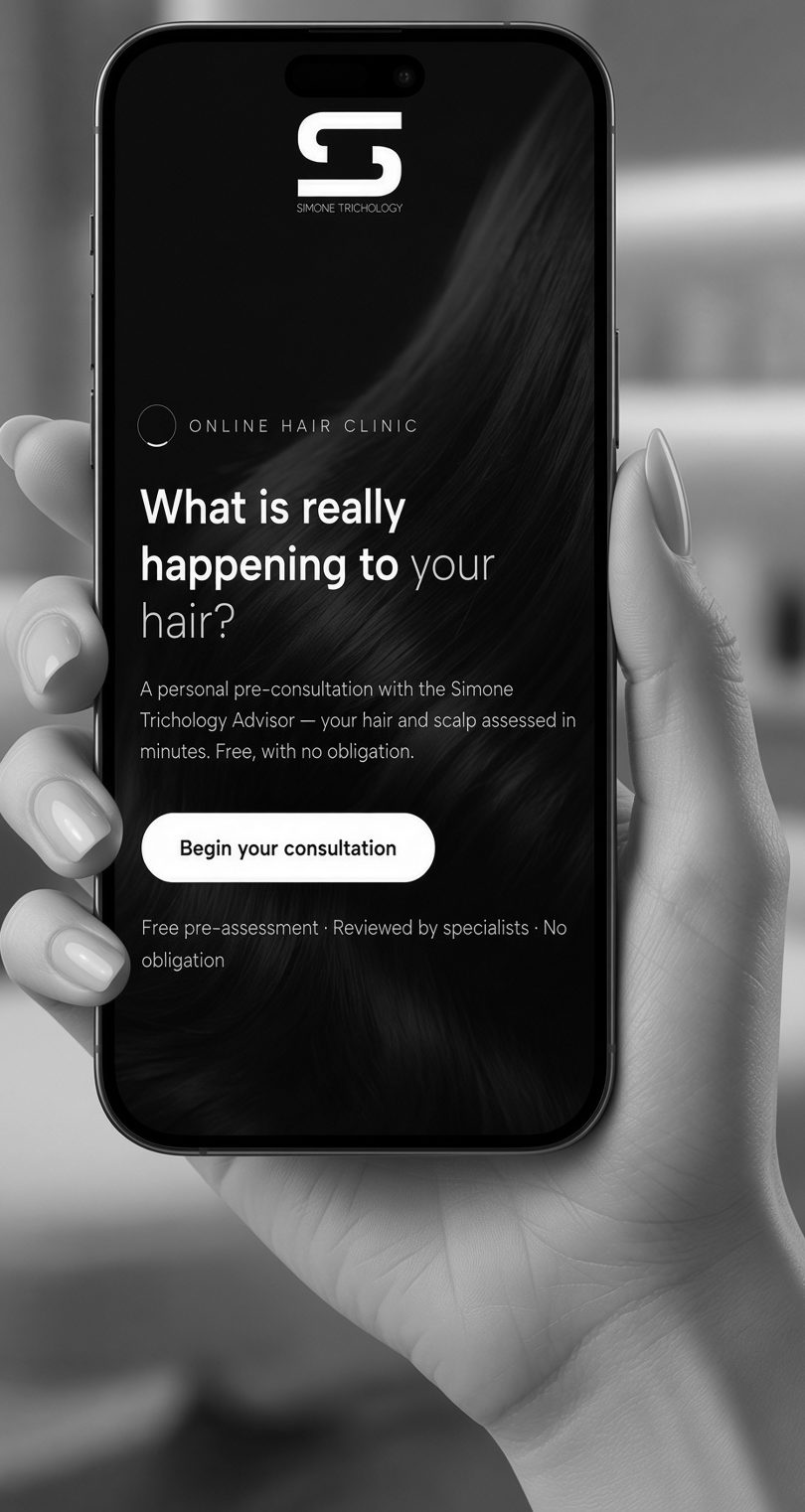
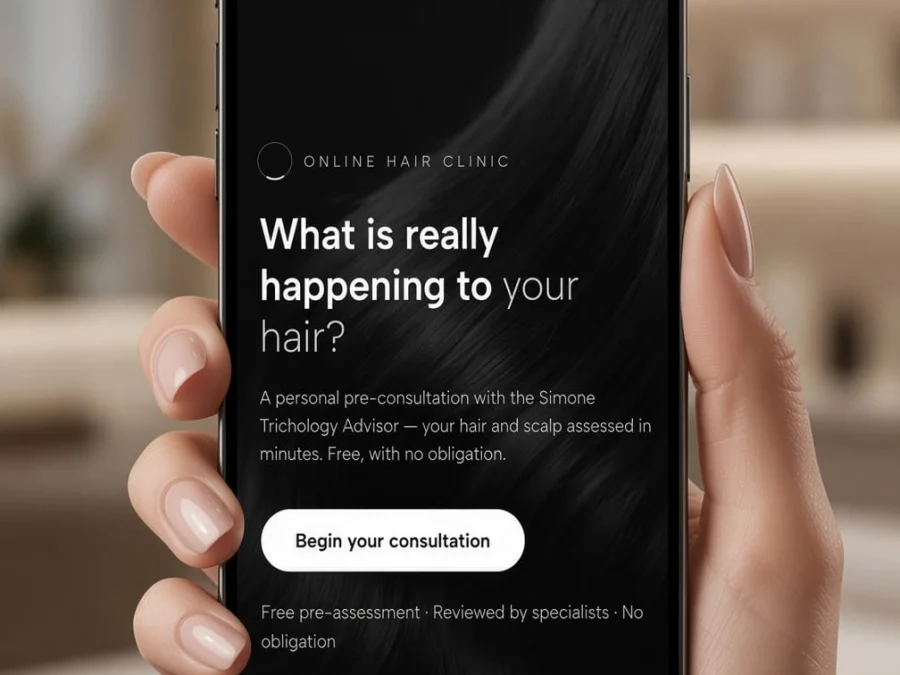
You cannot build an individual prevention-first routine without understanding your starting point. Our free online Hair Analysis collects information about your hair, scalp, routine and circumstances in five guided steps. Your photographs and answers are reviewed personally by our trichologist, who provides an individual cosmetic-care protocol with no cost or obligation.
This service is a preliminary trichological and cosmetic assessment, not a medical diagnosis. If the information suggests that medical evaluation is appropriate, we will recommend seeking it.
Scientific references
- Westgate GE, Grohmann D, Sáez Moya M. Hair Longevity—Evidence for a Multifactorial Holistic Approach to Managing Hair Aging Changes. Journal of Clinical Medicine. 2025;14(6):1894.
- Trüeb RM, Henry JP, Davis MG, Schwartz JR. Scalp Condition Impacts Hair Growth and Retention via Oxidative Stress. International Journal of Trichology. 2018;10(6):262–270.
- Guo EL, Katta R. Diet and Hair Loss: Effects of Nutrient Deficiency and Supplement Use. Dermatology Practical & Conceptual. 2017;7(1):1–10.
Reviewed by Pablo Ramos, lead trichologist at SIMONE TRICHOLOGY. Last reviewed: September 2026.
SIMONE TRICHOLOGY products are cosmetic products under Regulation (EC) No 1223/2009. They are not intended to diagnose, treat, cure or prevent any medical condition. If you notice sudden or patchy hair loss or persistent scalp symptoms, seek assessment from a qualified healthcare professional.