



Home › Trichology for beginners › Chapter 01
The Hair
Learn how the hair shaft, root, bulb and matrix are structured, where mitosis occurs, what hair is made of and how each phase of its growth cycle works.
 Est. 1989 — Spain
Human hair is a flexible, keratinised fibre produced by a living structure within the skin: the hair follicle. The visible hair shaft is biologically inactive, while growth takes place below the scalp inside the follicle.
Hair contributes to protection, sensation and temperature regulation, while scalp hair also has important cosmetic, social and psychological significance.
Hair root, bulb, matrix and shaft
Hair has two principal parts: the root, located within the follicle below the skin, and the shaft, the visible fibre that emerges from the scalp.
The lower end of an actively growing follicle expands to form the hair bulb. Inside it is the dermal papilla, a specialised cluster of connective-tissue cells supplied by small blood vessels. The dermal papilla sends signals that help regulate follicle activity, hair size and the growth cycle.
Where does mitosis take place in the hair bulb?
Mitosis takes place in the hair matrix, the rapidly dividing cell population in the lower hair bulb surrounding the dermal papilla. Matrix cells divide, move upwards, differentiate and keratinise to form the hair shaft and the inner root sheath.
This distinction is important: the dermal papilla helps control growth, but the actively dividing matrix cells produce the new hair fibre.
Once these cells have fully keratinised, they form the visible shaft. This is why cutting the hair cannot directly alter the activity of the follicle or make hair grow faster.
Medulla, cortex & cuticle
The mature hair shaft may contain three concentric layers. Their relative size varies with the diameter, type and location of the hair, so fixed percentages do not apply to every fibre.
The innermost region. It may be continuous, fragmented or completely absent, particularly in fine hair. Its presence and appearance vary between individual fibres.
The cortex forms most of the shaft. Its elongated keratinised cells provide strength, flexibility and elasticity, while melanin granules contribute to natural hair colour.
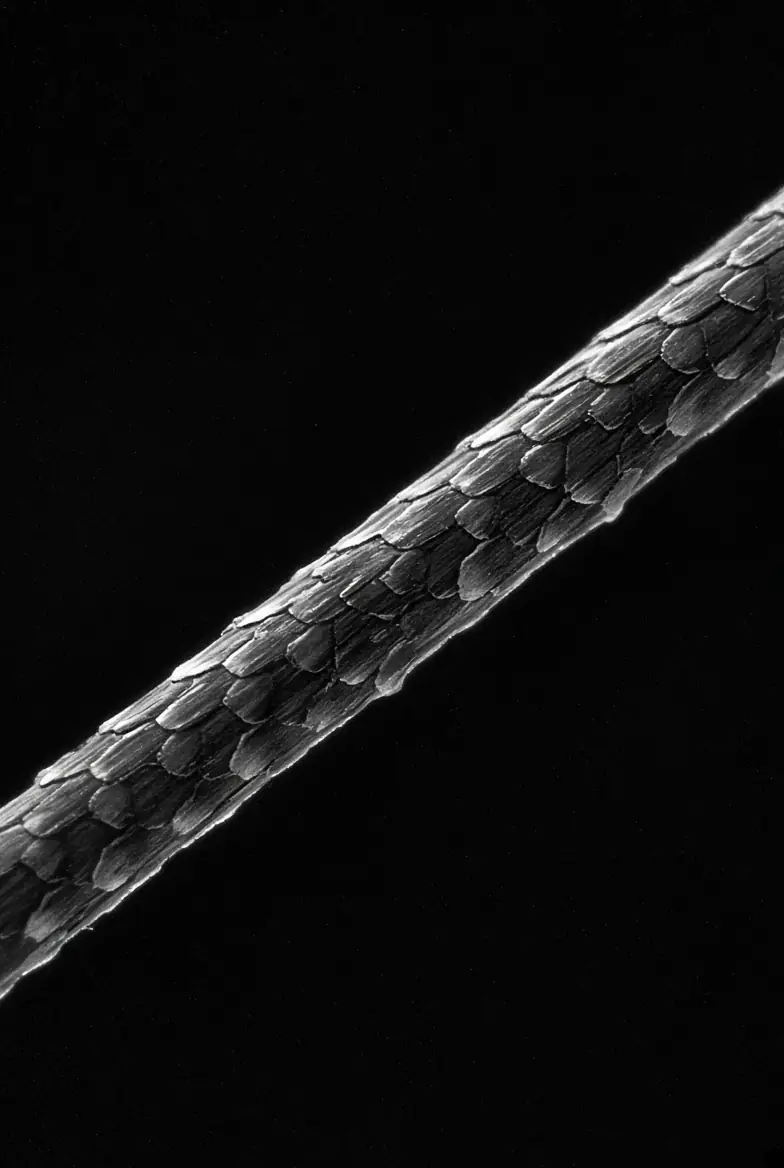
The outer protective layer, formed by flattened overlapping cells arranged like roof tiles. Damage to the cuticle increases friction, roughness, porosity, tangling and loss of shine.
How does hair grow?
Hair grows because matrix cells in the bulb divide and produce new cells. As these cells move upwards, they fill with keratin, lose their nuclei and become part of the emerging shaft.
Scalp hair grows at an average rate of approximately 0.3 millimetres per day, or about one centimetre per month. Growth speed varies with genetics, age, follicle location, health and other biological factors.
The length a hair can reach depends mainly on how long its follicle remains in the active anagen phase. Cutting the visible shaft does not change this internal biological programme.
Chemical composition of hair
The dry hair fibre consists predominantly of keratin proteins. Keratin is rich in sulfur-containing amino acids, particularly cystine, whose disulfide bonds contribute to the strength and shape of the fibre.
Hair also contains smaller amounts of lipids, melanin pigments, water and trace elements. Its water content is not fixed: hair absorbs moisture from its surroundings, so hydration changes with humidity and fibre condition.
Lipids surface & barrier
Melanin natural colour
Water humidity-dependent
The cortex contains most of the fibre’s keratin and pigment. The cuticle protects that internal structure, while surface lipids help reduce friction and water penetration.
The four phases of the hair growth cycle
Each scalp follicle follows its own repeating cycle. Neighbouring follicles are not normally synchronised, which is why growing, resting and shedding hairs can all be present at the same time.
Anagen phase
The active growth phase. Matrix cells divide rapidly and produce the hair shaft. On the scalp, anagen commonly lasts between two and six years and includes most healthy follicles at any given time.
Catagen phase
A short regression phase lasting approximately two to three weeks. Matrix-cell proliferation stops, the lower follicle contracts and the dermal papilla moves closer to the permanent part of the follicle.
Telogen phase
The resting phase, usually lasting around two to four months on the scalp. The club hair remains within the follicle while biological signals prepare it for a new growth cycle.
Exogen phase
The shedding phase in which the old club hair is released. Exogen can overlap with the beginning of a new anagen phase as the follicle starts producing its next fibre.
A shift involving an unusually large number of follicles can produce increased shedding several months after illness, major stress, hormonal change or another trigger. Persistent or visibly progressive loss should be assessed rather than attributed to the normal cycle automatically.
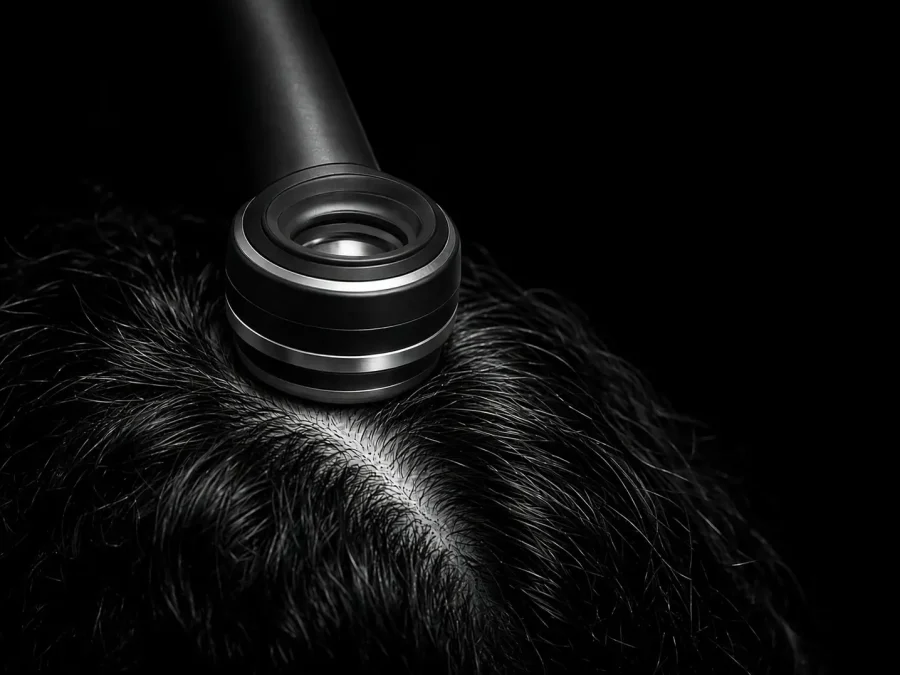
To learn how the phases can be examined, see our guide to the trichogram and trichoscopy. For the principal patterns and causes of loss, continue to Hair Loss & Alopecia.
Scientific references
This beginner’s guide was reviewed against current descriptions of hair-follicle anatomy, hair-shaft structure and the human scalp growth cycle.
- To grow or not to grow: hair morphogenesis and human genetic hair disorders
- The diagnosis and treatment of hair and scalp diseases
- On hair care physicochemistry: structure, degradation and conditioning
Last reviewed: September 2026. This information is educational and does not replace an individual diagnosis or medical assessment.
Start with a real assessment
Your scalp, read by a trichologist.
Three photographs, four minutes. Complimentary, reviewed personally within 24 hours.